


As a mom, I often have a conflicting narrative in my head. Especially when it involves choosing whether or not to take some time to myself. Recently, for example, I booked a HIIT workout class for some scheduled “me-time.” However, after having a busy morning and breaking the news to my kids that I’d be leaving before breakfast, I wasn’t surprised that I was met with their tears and opposition. I started to question if I should cancel my class or not. In many instances, not long after I’ve made a decision to have some me-time, the mom guilt usually sets in. The moment I feel like I’m unable to be readily available to them, it’s like I have to choose one or the other. This guilty feeling is a common occurrence, but why is that?
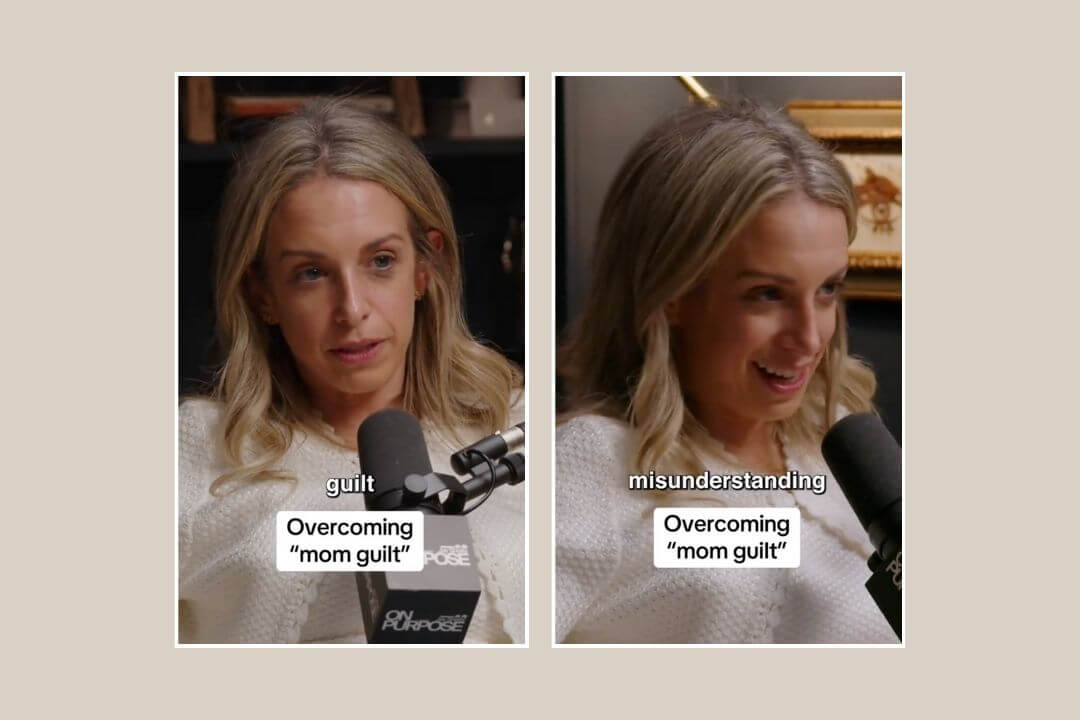
A coworker recently shared a snippet of a conversation on mom guilt on the Jay Shetty Podcast with guest and clinical psychologist Dr. Becky Kennedy. Dr. Becky’s response when asked how she overcomes mom guilt left me rethinking the idea of how it shows up in motherhood in certain situations. If you’re wanting to know what that guilty feeling really is, read on to find out how Dr. Becky redefines ‘mom guilt’ for all the mothers who sit with this heavy feeling at times.
‘Mom guilt’ defined
When moms are doing something that is beneficial for them, ‘mom guilt’ is a misunderstanding, says Dr. Becky. In defining guilt, the clinical psychologist says, “Guilt is a feeling you have when you act out of alignment with your values.”
She then gives a scenario of when a mom states she feels ‘guilty’ for going out to dinner with friends because her child doesn’t want her to go. While this can be a painful experience, Dr. Becky says it isn’t guilt. What this mom may be feeling is the weight of knowing that her child doesn’t want her to go. And ultimately, she’s turning her child’s feelings into her own.
It may not be guilt that moms are experiencing
So, what is it that moms are feeling then? Dr. Becky explains that moms are conditioned to have an awareness of when their children are upset. And in order to fix their child’s uncomfortable feeling, mothers tend to absorb it as guilt in order for their child not to experience a form of pain. Visually, this can look like a mom taking their child’s feelings out of their body and putting them in their own. This results in mothers calling it ‘guilt.’ In the end, a mom may choose not to participate in something like going out to dinner with her friends. “That’s not guilt,” states Dr. Becky, “That’s actually emotional confusion.”
“That’s not guilt,” states Dr. Becky, “That’s actually emotional confusion.”
What moms can do with emotional confusion
Per Dr. Becky, it’s important to know that two things are true. First, moms are allowed to go out and do something for themselves. Secondly, kids are also allowed to be upset, too. Dr. Becky has some insight into what moms may be doing when it comes to emotional confusion. She explains that they’re trying to rid themselves of a feeling that wasn’t theirs in the first place. If you’re experiencing emotional confusion with your own kids, Dr. Becky has some advice on how to deal with it.

Moms can visualize giving their kids’ feelings back to them
In order to separate your child’s emotions and yours, Dr. Becky advises moms to visualize pushing their child’s feelings back in their direction. Adding, it’s not pushing your kids away. According to Dr. Becky, “It’s giving [their feelings] back to [their] rightful owner.”
Parents can begin to empathize with their children
Once a parent ‘gives their child’s feelings back,’ they are then able to empathize with their child by validating what their child is truly feeling in that moment. Is their opposition because they’ll miss you putting them to bed? If so, empathizing can look like acknowledging this and letting them know, “This is one of those nights I’m going to dinner with my friends. It’s OK if it feels hard,” and following it up with, “You’re allowed to be upset. I will see you in the morning.”
Empathizing helps children build tolerance to distress
The response may not always be well received by children. Dr. Becky notes, “These interventions are simply not rewarded by kids’ [communication] behavior. The sooner we realize that, the better.”
The way Dr. Becky breaks down this form of mom guilt is helpful, especially if you’re a default parent. I think reframing the idea of mom guilt in this context will personally take some time. However, I feel validated in knowing me-time is OK as a parent. Plus, having the tools in how to empathize with my kids will help them deal with distress positively in the long run. So, the next time you find yourself being pulled in two different directions (especially between personal time and being with your kids), think about how Dr. Becky responded to overcoming what you think is mom guilt. She highlights two things can be true: Moms are allowed to do something for themselves, and children are allowed to be upset, too. If you’re wondering if I made it to my HIIT class, I did, and it was OK!
Related Stories:

Patty Schepel, Editorial Assistant
As the editorial assistant, Patty works with The Everymom’s team on pitches, creating original articles, updating existing content, photo sourcing, writing shopping product descriptions, inputting freelance articles, and more. With Patty’s passion for writing, experience as a mother of two, and expertise as a pediatric nurse, she brings a thoughtful and informative perspective to The Everymom. When she’s not working, you can find her spending time with her family, training for half marathons—she ran one 16 weeks pregnant—traveling, cooking, reading a rom-com, and keeping her sourdough starter, Rose, alive.
