


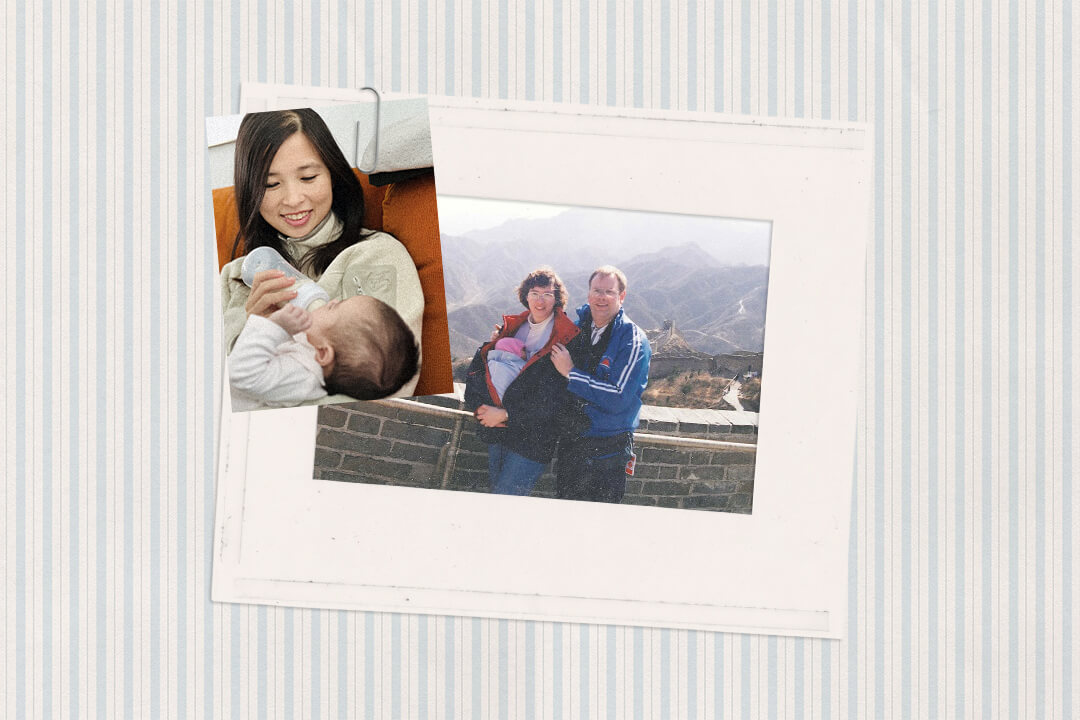
Abandoned at a few days old in a public location, I spent much of my first year in an orphanage and found a forever family from a small town in Canada at nine months old.
Adoption changed my life in many ways, providing access to a quality education, supportive immediate and extended family, and a chance to pursue a dream career and marriage. However, it also came with the sadness of never knowing my birth family and the longing to discover my past and identity.
I have always yearned to start a family, and last year, I gave birth to a daughter of my own. Few joys compared to the surreal peace, hope, and wonder as my newborn peered up for the first time and immediately found her home in my arms. Yet, at the same time, I found myself in the hospital delivery room processing my adoption in new ways, with the knowledge that my parents had left me during a similar time period in my own life.
Here are some reflections from my first year of motherhood as an adoptee.
Related Stories:
- Birth Mothers Share What They Want Adoptive Parents to Know
- 3 Ways Adoptive Parents Can Elevate Adoptee Voices This November
Grief comes in stages
Maybe it’s a grade school science project about your family tree. A doctor’s visit, when asked for medical history. Or your wedding day, when you look through the crowds for absent faces. Adoption is similar to other types of grief in that it can ebb and flow throughout life. Certain events can unexpectedly trigger sadness or reminders of loss. Following my daughter’s birth, I grieved the separation from my own mother, a few days after my birth, and the knowledge that I did not have any family present during several formative months.
Life milestones can bring new maturity
Although certain stages with your own child can be painful if your own parents were not present for whatever reason, I have found that new life experiences can also birth new understanding, acceptance, and compassion.
During adolescence, I would feel anger toward my birth mother. But much of my judgment stemmed from a child’s perspective, not a mother’s.
“During adolescence, I would feel anger toward my birth mother. But much of my judgment stemmed from a child’s perspective, not a mother’s.”
Raising a child is no easy feat from a financial or logistical standpoint. For instance, I cannot imagine raising my daughter without my husband’s support. Nor can I imagine having a child while facing government opposition, as during China’s one-child policy (a law that imposed significant fines and sanctions on families with more than one child from 1980-2016).
Pregnancy was very challenging for me, from the first trimester nausea to feeling so exhausted with back pain in the months leading up to delivery. The whole process of childbirth afforded a new appreciation for birth mothers who give and sustain life until birth. It takes courage to seek a better outcome for a child and to sacrificially put their needs first, in spite of your own physical and emotional pain.
The biological connection is powerful, but it’s not everything
For most of my childhood and adulthood, I dreamed of meeting my biological family. I underwent 23andMe DNA testing, imagined finding a long-lost sister, and fantasized about my parents. Growing up, I recognized I was genetically wired very differently from my adoptive parents and craved feeling understood.
My daughter is my first known biological connection (a connection I had very much looked forward to), but she is still in every way her own human being. I realize that, just like in every other relationship, nurturing her heart and supporting her uniqueness will take concerted effort, and not necessarily come naturally. Embracing her individuality provided closure by showing that a genuine depth of connection is established not through heredity, but by a constant pursuit of conversation, thoughtful observation, and quality time together.
“My daughter is my first known biological connection, but she is still in every way her own human being.”
As much as I loved my daughter at birth—after feeling her movements in the womb and watching her grow in ultrasound photos—my love for her has grown in seeing her overcome obstacles, meet milestones, and express her personality. I see more clearly now that family is the people who proactively love and seek to know the real you, and are not defined only by blood.
It’s possible to love again
Even if your past has been broken, adoption has shown me that history doesn’t have to define the future in terms of healthy and stable relationships.
First, I experienced unconditional love through adoption and then through creating a new family unit with my husband.
“Even if your past has been broken, adoption has shown me that history doesn’t have to define the future in terms of healthy and stable relationships.”
Experiencing attachment with my adoptive parents and then my own daughter showed me that cycles don’t have to repeat themselves. Full healing can happen when you accept unideal circumstances and choose to see the good in past trials.
My husband and I hope to eventually adopt. I know we will need to help that child process their own trauma, but we can also share what it means to be an overcomer and to hold the unique challenge and privilege of balancing multiple families and cultures.
I would tell an adopted daughter the same thing I would tell a biological one: Love makes us stronger. Every day is new with possibilities. The future is yours to write, and I will walk alongside to celebrate your unfolding story.

Leah Sutterlin, Contributing Writer
Leah Sutterlin is an adult adoptee living in Cupertino, California, with her husband and daughter. After working in business and technology, Leah recently pivoted to the non-profit space, supporting foster care and adoption with organizations such as The National Council for Adoption, Help One Child, and the Christian Alliance for Orphans.
