

I exclusively pumped for almost eight months with my second daughter. While I was glad to be able to provide breastmilk for her even though breastfeeding didn’t work out, it was tough in a lot of ways. And it’s worth noting that I’m a big believer in fed is best. My first daughter was exclusively formula fed, which is what worked for us then. When I was pumping, though, one of the things that always left me baffled was how one breast’s output was always dramatically different from the other—I had a “slacker boob.”
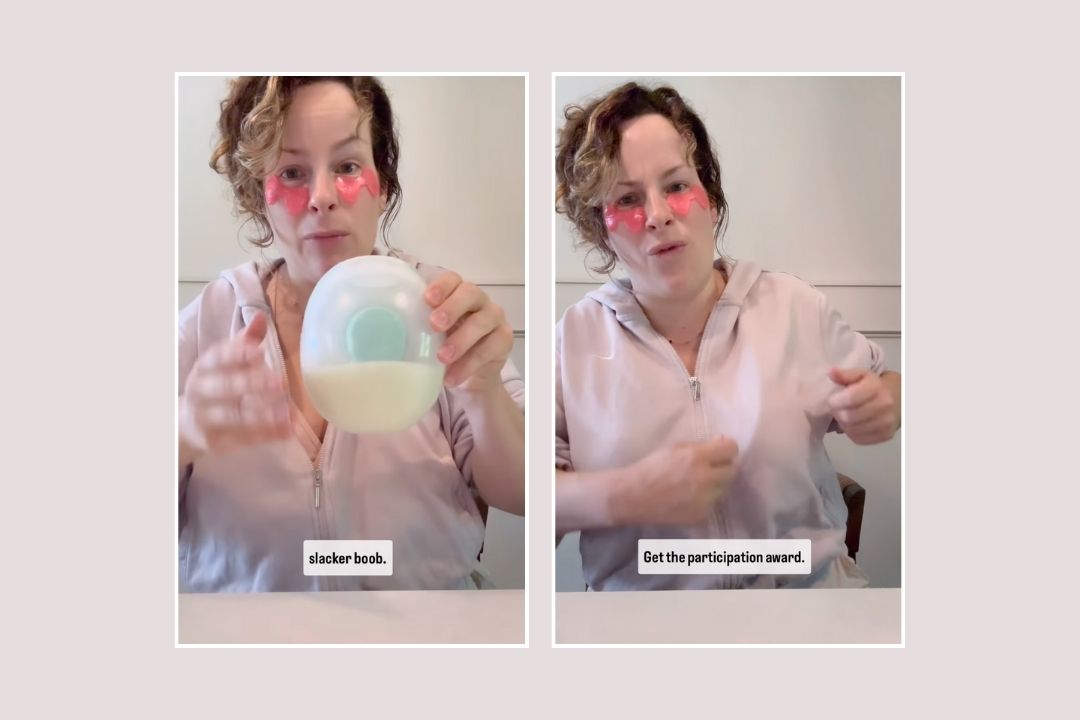
So when I saw popular content creator Emily Vondy’s recent viral reel about her slacker boob, I couldn’t help but laugh out loud. In the reel, Vondy is wearing a Willow Go wearable pump while sporting cute undereye patches as she tries to hype up her underperforming breast.
She raps to her slacker boob about how her “performing” breast is “waking up early while you’re hitting snooze” and comments that “she’s putting out five and you’re putting out two.” But she’s also quick to thank her slacker boob for showing up at all, and says it should get a participation award.
I talked with Dr. Laurie Jones, Chief Medical Officer at Willow to learn more about how common slacker boobs are, and if there’s anything you can do about them. Read on for what she had to say.

Laurie Jones, MD, IBCLC
Dr. Jones is a practicing pediatrician and Clinical Assistant Professor of Pediatrics at the University of Arizona School of Medicine. Her expertise involves the full-spectrum of pediatric care, as well as breastfeeding education. She is the founder of Dr. MILK (Mothers Interested in Lactation Knowledge), a breastfeeding support network of 35,000+ participants. She is a mother of two.
A slacker boob is totally normal
First and foremost, Dr. Jones says having a slacker boob is quite common and that it’s rare for both breasts to produce the same amount of milk. “The differences between left and right can be either subtle or extreme,” she says, “and [the differences] can occur early in the journey or later.”
“Having a slacker boob is quite common and it’s rare for both breasts to produce the same amount of milk.”
She says a slacker boob can be extreme, with one breast producing nearly all of the milk. But it can also be mild, with only an ounce or two difference per side for each pumping or breastfeeding session.
Reasons why you might have a slacker boob
There are several reasons why you might find yourself with a slacker boob while you’re on your breastfeeding journey. Dr. Jones says that a slacker boob may develop early on if moms have a dominant hand position for latching positions. If you’re always latching your baby on the right, it might be more likely that your left breast will be the slacker.
Babies may also develop a preference for one breast or another which can contribute to a slacker boob. “If there is a preferred breast, the other breast may experience lower production in the early stages, leading to hypertrophy in the opposite breast,” Dr. Jones explains.
Over time, not fully emptying your breasts can also lead to lower production and a slacker boob. She says sometimes a mom won’t realize that she’s fully emptying one breast when pumping or breastfeeding and not the other.
“If mom consistently leaves milk behind in the breast, her body decreases production to match what was removed,” she says. If you are fully emptying your right breast but not your left, then your left breast will become your slacker boob.
Dr. Jones also mentions that not having the right flange size for pumping can lead to a slacker boob. She recommends pumping moms should measure their nipples often to make sure they have the right flange fit. Most pump companies include a guide for how to find the right flange size, but there are also companies like One With The Pump that can provide 1:1 virtual sessions to ensure you are using the right size.

Is the slacker boob always the left breast?
Several comments on Vondy’s reel talked about the slacker boob always being the left breast.
“My left side was a slacker too,” said @feedinglittles while @jessie_duPree commented, “It’s always the left side! I had four [littles] and my left was always the slacker.”
It may feel like a conspiracy theory, but Dr. Jones says that the generalization may have some validity. She explains that 75 percent of torticollis in babies, commonly called neck tightness, is on the left side. That means that your baby might latch easier on your right breast or prefer your right breast. And if they’re eating more from the right breast, production on the left would naturally slow, making it a potential slacker boob.
That said, you may very well find that your right breast is your slacker boob based on your baby’s preferences.
How much breast milk should you be producing?
I fell into a social media trap when I was pumping after seeing so many moms showing pictures of getting 5-8 ounces per breast for each pumping session and massive freezer stashes. It sent me into a spiral thinking I wasn’t producing enough milk. And, as a result, I spent way more time chained to my pump than I actually needed to.
Dr. Jones cautions about this, too. “Many people have unrealistic expectations,” she says. “If your baby is growing according to the growth chart with your combined [milk] output, then you do not need to increase the ‘slacker boob.’”
“Many people have unrealistic expectations. If your baby is growing according to the growth chart with your combined [milk] output, then you do not need to increase the ‘slacker boob.’”
She says that it’s normal to produce between 1-1.25 total ounces of milk per hour when your baby is under 6 months old. If you pump every three hours, a normal output would be 3-3.75 ounces total. For eight pumping sessions a day, that would be 24-30 ounces a day.
Vondy also talks about this in her video’s comments to remind other moms about what is realistic. “For those worrying about supply, I should put the disclaimer out that this was my morning pump,” she mentions. “I only get output like this in the morning. If I pump [during] the day, I’ll get 2 or 3 ounces out of my left and 1 ounce out of my right. Which is enough to feed my baby.”
As your baby gets older, you should expect your pumping volume to decrease as your baby eats more solid food. Dr. Jones says the average output is closer to 16-18 ounces a day at 12 months postpartum.
Increasing milk supply in a slacker boob
If you find you truly do have a slacker boob and aren’t producing an average amount of milk, Dr. Jones says there are a few things you could try to “fix” it and increase output.
“Complete and frequent emptying is the BEST way to increase production,” she says. You can also try power pumping or just pumping on your slacker boob after breastfeeding to try to “resuscitate” it.
She does mention that trying to increase your milk supply is often easier earlier in your pumping or breastfeeding journey as you’re more likely to have a higher milk supply the earlier you are postpartum.
“Unfortunately,” Dr. Jones notes, “there are few to no studies that examine the breast as an organ, similar to the way research is conducted for the liver, kidney, or heart.” This makes it hard to know for sure why some moms have higher milk production than others or to give recommendations for how to definitely increase production.
You’re doing great, just like your slacker boob
“I’m just happy you chose to show up and participate,” Vondy assures her slacker boob as she finishes her pumping session in her funny video, which now has more than 61,000 likes on Instagram. So, pat yourself (and your slacker boob) on the back if you are pumping or breastfeeding. It’s hard work and you both deserve an award.

Elliott Harrell, Contributing Writer
Elliott is a mom of two little girls and is based in Raleigh, NC. She spends her days running a sales team and doing laundry and her nights writing about the things that she loves. She’s passionate about all things motherhood and women’s health. When she’s not working, writing or parenting you can find her trying a new restaurant in town or working on her latest needlepoint project.
