


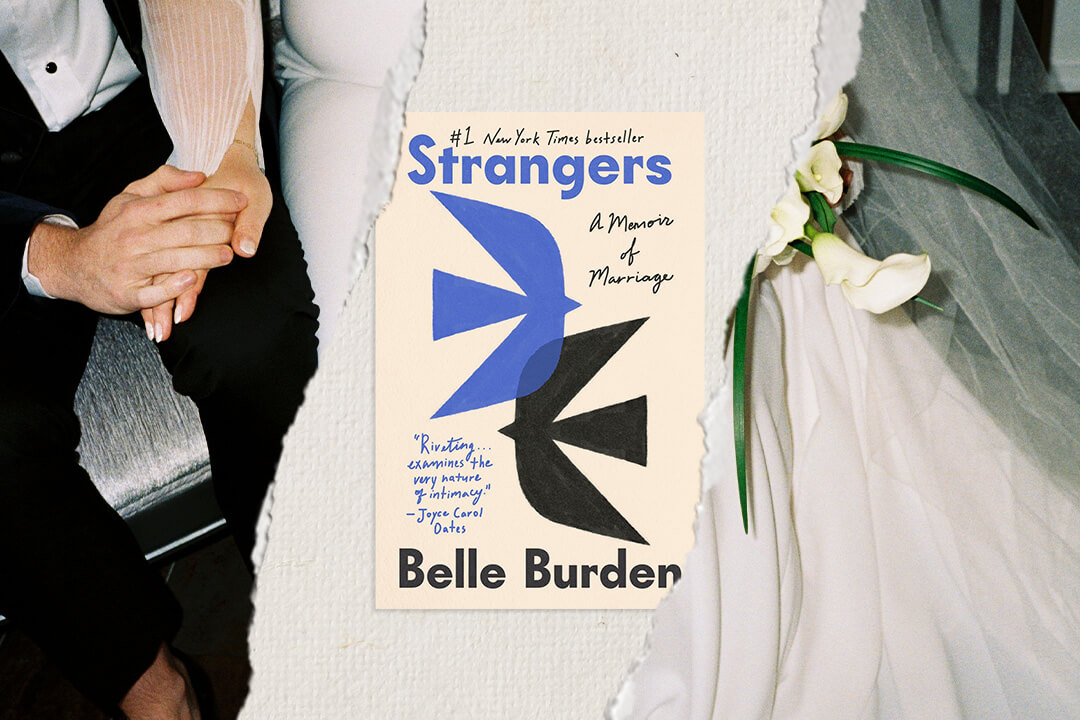
In Strangers: A Memoir of Marriage, author Belle Burden reflects on her decades-long marriage and the sudden collapse of the life she thought she understood. The book has been making headlines and sparking hot takes, with Gwyneth Paltrow set to executive-produce and star in the Netflix book-to-movie adaptation. I just finished Strangers, and what unfolds is far bigger than a story about marriage, betrayal, or divorce.
Strangers is the story of a woman being broken open. It’s about loving deeply, losing deeply, and slowly disappearing into your own life—and then finding the courage to choose yourself anyway. The words on the page feel like a rebellion against what was expected of her, and of all women. It shows that through the telling of our stories, we can survive them. We can heal from them and extend our hand to someone who needs it. It’s the book I wish I had read earlier, before my own marriage and divorce. Here’s why:
What is the book ‘Strangers: A Memoir of Marriage’ about?
In March 2020, Belle Burden was a happily married woman in the United States, navigating the early days of the pandemic with her family by her side. Then—practically overnight—her husband became someone she didn’t recognize, exiting her life swiftly and leaving Belle heartbroken and lost. In Strangers: A Memoir of Marriage, she revisits her relationship, searching for clues that her husband wasn’t who she thought he was.
Seeing my story reflected in Belle Burden’s ‘Strangers’
One of the first things that struck me while reading Strangers was a moment when Belle Burden described her husband suggesting that they tell people their divorce was “amicable.” This is just days after she learned of his affair, and he abruptly leaves their family at the start of the pandemic while they’d been sheltering on Martha’s Vineyard with their teenage daughters. She writes that literally everything in her body rejected this idea. Her immediate answer was an emphatic “No.” She would not lie about it. Telling the truth about what happened would be her only chance at surviving it.
As someone who has recently gone through a divorce, I related immediately to the feeling Burden describes so vividly, that visceral feeling where your whole body says, “No.” No, I will not do as I am told any longer. I will not smooth out the edges. I will not think of his wishes before my own.
“No, I will not smooth out the edges. I will not think of his wishes before my own.”
Finding rebellion in my intuition
And that feeling she describes, I understand now, that is her intuition coming back online. That connection to her body before her brain could talk her out of it—before she could override herself with all the things women have inherited for generations:
This would make things easier for everyone.
This would be better for the children.
This is what a good wife would do.
This is what my mother would have done.
Protect the marriage. Protect the image. Protect the man.
Absorb the pain quietly.
But she didn’t do that. This was her first rebellion. And it was the first reclaiming of her voice, her truth, and herself.
What struck me most was that this woman of enormous privilege—in a high society where appearances mean everything—chose herself. It seemed the alternative was not only disappearing into the grief and the shame, but quite literally disappearing altogether.
And maybe she had been slowly disappearing inside her own life for a long time and hadn’t even realized it. In Strangers, Belle Burden describes a switch going off in her husband, but it almost feels as though a switch flips on inside of her. Suddenly, she can start to see her own story with more clarity.
Deciding I wouldn’t hide the truth
In the early days of separating from my former husband, I was simultaneously grieving, devastated, disoriented, and, in my case, strangely ecstatic to finally be out of a marriage that had become deeply painful. It was also the end of the school year, and my son was finishing pre-Kindergarten. We made the decision to give him the gift of time and have him repeat the year instead of going off to kindergarten. Given our new reality and all the changes happening at home, it felt even more like a blessing.
“In the early days of separating from my former husband, I was simultaneously grieving, devastated, disoriented, and strangely ecstatic to finally be out of a marriage that had become deeply painful.”
But selfishly, I was already anticipating what came next: a new class, new parents, new social circles, and now entering all of it as the divorced mom.
So when I saw “End of Year pre-K Parents Night Out” on the calendar, my head immediately told me this was one to skip. Over time, I would naturally have less interaction with this group anyway. It would have been perfectly understandable not to go. But something in my whole body said, “No, I will not hide. Do not stay home. Just get there.” So, I showed up.
I remember on the way there thinking I should probably have a game plan. What exactly was I going to say, if anything? Would I share that my marriage was ending? That I was falling apart? Or should I just white-knuckle it and get through the night?
I walked into the bar filled with couples and parents talking about their shiny summer plans, vacations, their children, their trips to Michigan with their coupled-up family and friends. And yet, I also knew these people didn’t have perfect lives either. No one does.
And so I did it. I blurted it out right there in a group of women, “We are getting a divorce.”
I almost couldn’t believe it myself. Am I really doing this? But saying it out loud became an act of trusting myself. I was giving less weight to what everyone else might think. I refused to deliver things in a pretty package to make my situation more comfortable for other people. It became my first rebellion, and maybe if I could show up honestly, I could start rebuilding my own life: messy, painful, beautiful, and all mine.
In that moment, and in so many moments afterward, it became my way of saying: This happened to me. What happened to me matters. I matter.
Sharing my story opened others up to tell theirs
And what surprised me most was not that everyone suddenly had the perfect thing to say. As Belle Burden writes in Strangers, some people moved closer to her, others physically moved away. What surprised me was that in claiming my story, it gave other people permission to tell the truth about their own lives, too.
People started sharing stories of their parents’ divorces, their siblings’ divorces, their own unhappy marriages, or even their happy marriages—that still carried disappointment and struggle underneath the surface. Several people admitted that their own parents had stayed together far too long “for the kids,” and that it had caused its own kind of damage.
“People started sharing stories of their own unhappy marriages or even their happy marriages that still carried disappointment and struggle underneath the surface.”
In those early days, the thing I carried most heavily was the fear that I was ruining my child’s life. That fear alone kept me in my marriage far longer than I should have stayed. And hearing my peers tell me, “I wish my parents had separated sooner,” or “children need to see their mom happy,” didn’t erase the grief, but it did feel like a life raft.
A few days later, I found myself sitting with another mother from the school. We were two strangers baring our souls, sharing intimate details of our lives and the unraveling of them. And while grieving, I started to feel hopeful again. Maybe my life, while different from what I imagined, could someday become even more fulfilling than the one I once believed I could never live without.
Lessons from ‘Strangers’ for all women
That’s why stories like Strangers matter. Not because we are trying to dissect every red flag and perfectly avoid heartbreak. That conversation has value, and we absolutely need language for emotional imbalance, self-abandonment, manipulation, control, confusion, and the subtle ways relationships can erode over time. But I don’t think Belle Burden’s Strangers is resonating because it gives us a roadmap for avoiding pain. I think it’s resonating because women are being brave enough to tell the truth.
“I don’t think Strangers is resonating because it gives us a roadmap for avoiding pain. I think it’s resonating because women are being brave enough to tell the truth.”
I know some people will focus on Belle Burden’s privilege, her wealth, her social world, and decide they can’t relate. But I think that misses the point of Strangers entirely.
Staying awake inside love
Yes, the details of her life may look different than most women’s lives. However, the emotional experience of slowly disappearing inside a marriage, waking up inside grief, and trying to rebuild your entire life and identity afterward is profoundly universal. I see a woman who loved deeply, lost, and refused to disappear in the aftermath. It’s the process of trying to break a generational cycle of women protecting men at the expense of themselves. I see Burden as a woman honoring her own truth without needing revenge or retribution.
And I think that’s why this book is reaching women across all ages and walks of life: married women, divorced women, single women—women who are happy in their marriages and women quietly questioning them.
Because even happily married women understand, on some level, the vulnerability of loving another person deeply. They understand how easy it can be to slowly orient your life around someone else’s needs, career, rhythms, preferences, and emotional landscape.
And I think many women reading Strangers are not just asking, “Could this happen to me?” They’re also asking, “Am I still connected to myself inside my own life?”
The myth of safety
We all want reassurance that painful things happen according to identifiable rules. We want to believe that if we make the right choices, ask the right questions, marry the right person, or love hard enough, we can somehow guarantee ourselves safety. But life rarely works that way.
Emotionally intelligent women still end up in painful marriages.
Good people still miss things.
Relationships deteriorate slowly.
Confusion is often more present than certainty.
And maybe that’s actually one of the most powerful takeaways from Strangers.
If we can accept that even beautiful love stories sometimes fall apart, then perhaps we can start having more honest conversations with women much earlier. Not from a place of fear or cynicism, but from a place of agency. It’s about having transparency about finances, caregiving, sacrifice, and the realities of building a life with another person. Because marriage is not only emotional. It is also logistical, financial, legal, and deeply intertwined with a woman’s mental and physical health, earning power, identity, and future.
“Marriage is not only emotional. It is also logistical, financial, legal, and deeply intertwined with a woman’s health, earning power, identity, and future.”
Because the reality is that women still lose disproportionately in divorce on nearly every level. And far too many of us enter marriage wildly undereducated about what can happen at the end of one.
The most important relationship to have
When I got divorced, I realized how little women actually talk honestly about any of this. Not because we are pessimistic, but because we are conditioned to focus almost exclusively on the love story. The feelings. The chemistry. The butterflies.
And of course, those things matter. As Burden writes, we should love without abandon. But maybe we need to learn how to apply that same thinking to ourselves, too. To remain connected to ourselves inside our own lives, our own relationships, and our own stories.
Because perhaps the most important relationship that any woman will ever have is actually the relationship she has with herself.

Katy Kliebhan, Contributing Writer
Katy K. writes about modern womanhood, motherhood, grief, healing, and the beauty of starting new. She is finding joy in building a life that is wholly her own, one guided by creativity, connection, and possibility. A former working mom turned stay-at-home mom, Katy is now embracing a season of reinvention and sharing what she loves along the way.
Images in feature graphics credited to Elevae Visuals and Amazon.
