


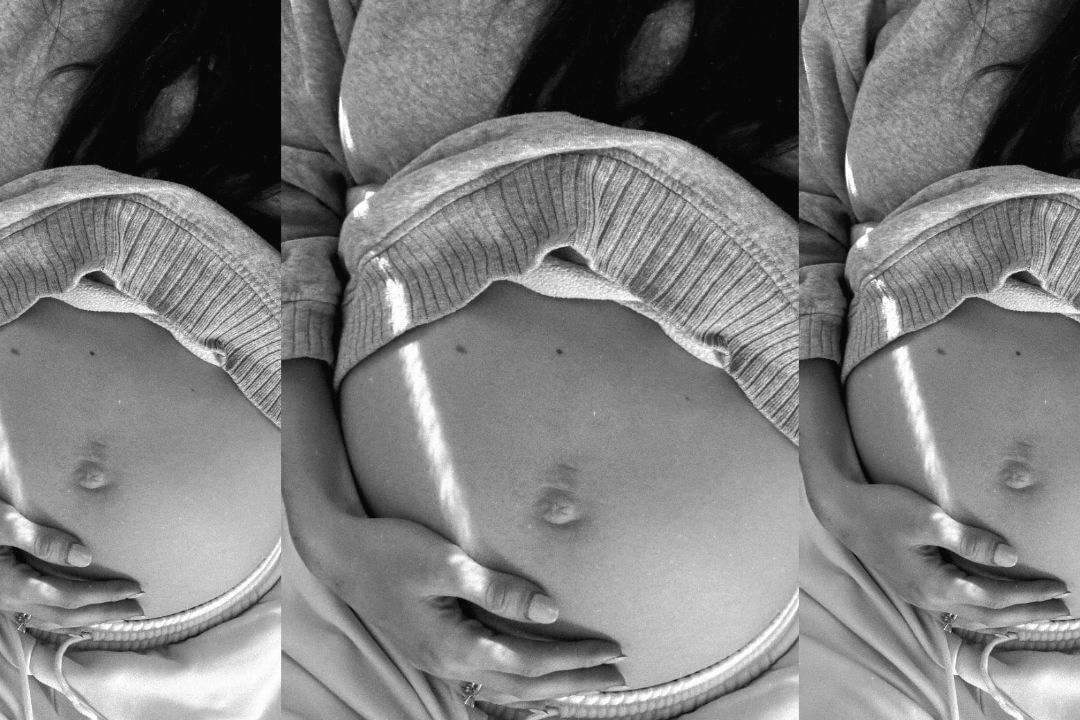
Living in Los Angeles, being 40 years old and pregnant is certainly not an anomaly. The only place it is noteworthy is at the doctor’s office. While the proper medical term has gone from “geriatric pregnancy” to “advanced maternal age”—a major glow-up—it is still considered a “high-risk pregnancy.” With that comes additional testing, closer observation, and quite often, early induction. It was at one of my first OB-GYN appointments that my doctor mentioned inducing labor at 39 weeks. At that point, my thinking was, “That sounds like a decision for third-trimester me.”
Well, the time has come, and I’m uncomfortably hobbling along at the end of my third trimester. I’m currently 37 weeks pregnant and scheduled to be induced at 39 weeks (and 2 days to be exact). An induction of labor, to be clear, is defined as “a common obstetric intervention that stimulates the onset of labor using artificial methods.” Here’s what I’m considering about induction during my final weeks of pregnancy.
Read More:
- The Everymom’s Ultimate Hospital Bag Packing Checklist
- Postpartum Physical Therapy Saved Me After Childbirth—But I Didn’t Even Know to Ask For It
Choosing whether to get induced at 39 weeks
Deciding to be induced early was a decision made with mixed emotions. Knowing that there is an end date has given me a sense of relief. The odds of delivering on your due date are actually pretty low. I can’t think of one friend who did! But with an induction, I know I’ll be heading to the hospital on that exact date.
Of course, I could go into labor beforehand, and all of my overthinking would be for naught. I can hear my late grandmother saying one of her favorite expressions, “We make plans, and God laughs.”
I’d been induced before
I was induced with my son, and overall, his birth was a positive one. The difference, though, was that I was five days late, at 41 weeks. There were things I very much liked about the experience. Unlike what I had imagined labor to look like, I didn’t show up to the hospital in a complete panic, screaming like a madwoman. It was all very civilized. I was given Cytotec, an induction pill, and never had to use Pitocin. My body responded well, the contractions came on gradually, and I had my son by the end of that day. If this time around is anything like the last, I’m all for induction.
It made planning for childcare easier
Furthermore, when you have a toddler, the logistics of giving birth get a lot more complicated. Knowing when I’m going to be induced has helped me plan for who will take care of him when we go to the hospital.
It kept certain fears at bay
My husband has a very important work event right around my due date. By scheduling the elective induction, he will likely be able to attend. Lastly, we live a bit far from the hospital, and LA traffic is a huge factor. My biggest recurring nightmare (literally and figuratively) is being on the 405 in standstill traffic while in labor. Having an induction scheduled has helped keep these fears at bay.
I asked other women about inducing labor at 39 weeks
I lean toward indecisiveness, so I usually solicit several opinions before making a decision. Often, it’s not the most helpful, as I’m easily swayed, but it’s what I do. When you’re 40, there are lots of women to ask about their own birth experiences. Some friends were induced at 39 weeks and loved it. Others hated it. One friend said the Pitocin made the contractions come on so strongly, and using it made her feel as though she lost control over her own body. Another said it was all quick and relatively painless, and she’d choose that option every time. Anecdotally, it’s hard to pick a side.
Is an induction done to benefit the healthcare system?
There is a certain distrust of the hospital system, and understandably so. Just recently, this New York Times article made waves about fetal monitoring leading to unnecessary C-sections. You can dig into the profits from performing this surgery. It’s the thing I feared most about choosing to have an early induction.
When scheduling my own induction, my OB-GYN wanted to get it on the calendar pretty early on, since the hospital “gets so booked up.” Furthermore, I’ve heard stories of inductions being scheduled because the doctor is on vacation or to avoid a major holiday. Choosing the timing based on the extraneous scheduling rather than the body’s progression seems a bit icky. That being said, the unmedicated home birth route is one I would never take. I mean, never. Props to the women who want to experience the “beauty of birth,” but for me, the less I feel, the better.
“Props to the women who want to experience the ‘beauty of birth,’ but for me, the less I feel, the better.”

Trust your doctor, but also do your own research
I chose to lean on my OB-GYN and trust her word. I brought up my concern: Does being induced at 39 weeks increase my chances of a C-section? She told me that it does not. In fact, she said that some recent studies have shown the exact opposite. Considering I didn’t have a C-section with my first child, she said the chances of that happening are very low.
I went home from that appointment and did some of my own research. While there have been several studies on medical induction, most of what I saw focused on first-time births, a.k.a. nulliparous women (new word of the day for you all). After some more digging, I came across a review in The Journal of the American Medical Association (JAMA) that included 14 studies comparing outcomes of 39-week inductions with waiting for labor to begin. The study showed that induction at 39 weeks proved better results for both the mother and child, and for multiparous women only (those who had at least one prior birth—that’s me!), “a substantial reduction in the likelihood of emergency cesarean section.”
I decided to stop my research there; the findings are in my favor. Also, my toddler was screaming for me to get him a snack (oh, mom life).
Embracing the unknown
At my appointment today, I had a cervical check. Undilated, my doctor doesn’t think I’ll go into labor before my due date. But if ever the expression “you never know” is to be used, it should apply to giving birth. Our bodies are amazing, but they’re also unpredictable. So while my scheduled induction has given me a sense of control, I also realize I have to be okay with whatever ends up happening. You can’t fully control your own birth. But, induction or not, there’s a new family member on the way. That is where I’m choosing to focus these next few weeks… or days. You never know!

Dyana Lederman, Contributing Writer
Dyana is a lifestyle and travel journalist, creative writer, editor, and producer with 15+ years of experience. A soon-to-be mother of two, Dyana lives in Redondo Beach and loves to share stories and insights into parenting. In the past, she worked in television and podcasting, and her first children’s book, Chester Gets a Baby, debuted in summer, 2025.
