


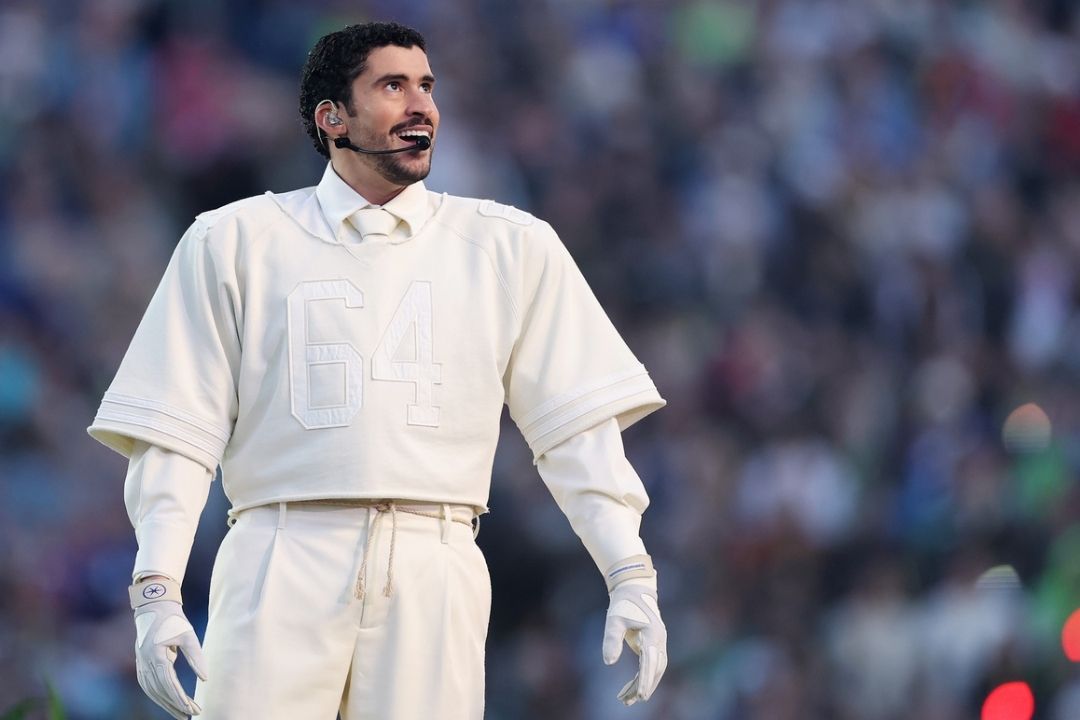
“Mama, Puerto Rico!!!” Watching my kids during Bad Bunny’s Super Bowl halftime show brought me to tears. As a Puerto Rican who left the island at a young age, I never imagined my kids or me seeing our heritage, dialect, and traditional music on the world’s most-watched stage. And I’m not surprised that it was Benito who achieved this feat, exclusively in Spanish.
I remember hearing his unmistakably baritone voice with our unique accent on a local English pop station in Texas back in 2018, and I couldn’t believe that my favorite up-and-coming Puerto Rican artist was crossing over. It’s been nearly a decade since, and he’s continued breaking barriers all while being unapologetically himself. I’ve been lucky enough to watch that growth first-hand, most recently at his Residency in Puerto Rico last summer. But now the rest of the world is discovering what many Puerto Ricans and Latinos already knew: Benito Antonio is on a mission to bring our culture to the forefront. And it’s a mission I’m incredibly proud my children get to witness as they grow up.
“But he’s not kid-friendly!!!” I’m sure many people are thinking, and I won’t wholly disagree with this sentiment. Bad Bunny himself has said on numerous occasions that his music isn’t for children. I only play his more PG songs around my kids, especially as they’re starting to understand Spanish. However, you’re never too young to understand the symbolism of unity.
Breaking down the symbolism in Bad Bunny’s Super Bowl halftime performance
This was bigger than the music. He proved that on Sunday, especially as his songs became the background while bringing our island’s history, struggles, and rich culture to the forefront. He’s already been doing this for years, and this time he went harder than ever.
A time-lapse of Puerto Rico
Bad Bunny began his set with one of his most popular songs, Titi Me Pregunto, while his dancers simulated cutting sugar cane as they wore traditional pava hats. A representation of the island’s complex agricultural history, from the period of colonization using the forced labor of native Tainos and enslaved Africans for profit, to the eventual displacement of local farmers because of the U.S. sugarcane industry. Most Caribbean people resonated deeply with this imagery because their ancestors endured the same struggles.
As he continues singing and walking through the tall grass (anyone else hooked on grass people POV videos rn?), we’re thrust into more modern depictions of the island. We see glimpses of our diverse people and customs at every corner: the coco frio and piragua stands, viejitos playing dominoes (Benito’s favorite game), girls getting their nails done, a jewelry vendor, professional boxers Xander Zayas and Emiliano Vargas, and even a cameo from Villas Tacos, a local L.A. taco stand. Knowing that the show featured real small businesses from the Latino community made it even more special. We’re left with the impression that despite the island’s tumultuous beginnings at the hands of colonizers and invaders, our people still found a way to persevere.
La casita
BadBo’s casita has traveled with him from his Residency in San Juan to his Latin America tour, so of course, they had to bring it to the most-watched stage. And this time, he invited the entire world to his iconic “pari de marquesina” (house party). Perreo was the focus here, as his dancers and huge Latinx celebs Pedro Pascal, Jessica Alba, Cardi B, and more moved their bodies to the classic rhythms of reggaeton. And yes, there was a lot of booty shaking. I understand if it makes those outside of the community uncomfortable. However, many people around the world emphasize hip movements while dancing, so while it’s unfamiliar to some, it’s simply a part of the culture to others.
You can skip ahead or prepare a kid-friendly explanation if you plan to rewatch the performance with your kids, because for many Latinos, this was an expression of joy, love, and resistance. Another notable moment during this set is his homage to old-school reggaeton artists who paved the way using samples of songs by Tego Calderon, Daddy Yankee, and Don Omar.
The wedding
After the dance party ends, Bad Bunny delivers a quick message to the camera, “If today I’m here at Super Bowl LX, it’s because I never stopped believing in myself. And you should believe in yourself, too. You’re worth more than you think.” Then the most insane moment happens as we witness a couple wed on stage—and yes, they really did get married! The crowd dispersed to reveal Lady Gaga styled in a light blue gown that matches our independence flag by Dominican designer Luar and accessorized with our national Flor de Maga designed by Piers Atkinson. Talk about a crazy story for their grandkids. And like every good Latino wedding, their nuptials were celebrated with a huge party and a whole lot of salsa.
“If today I’m here at Super Bowl LX, it’s because I never stopped believing in myself. And you should believe in yourself, too. You’re worth more than you think.”
Gaga’s guest appearance was an unexpected surprise for me, but Benito has stated he’s a huge fan of her work. She felt like the perfect person to bridge the gap between Spanish and English speakers with her salsa rendition of Die with a Smile. Personally, I think it was also his way of taking a dig at those who thought an English speaker should have performed instead. Accompanying Gaga’s powerful voice, we saw Los Sobrinos, a Puerto Rican salsa band that plays on Bad Bunny’s recent album and at his tour. The wedding portion ends with him singing his hit song Baile Inolvidable, and we even see him pretend to wake up a kid asleep on chairs as the party rages on around him—a nod to a universal Latino experience.
Nuevayol and the diasporicans
We follow Benito into the diaspora with Nuevayol, depicted with recreated cultural Latino landmarks like La Marqueta and Toñitas, where Toñita herself serves him a drink. Although he was born and raised on the island, he never misses an opportunity to recognize those of us who had to leave. New York has always been a hub for Puerto Ricans and many other Caribbeans, especially after the great migration during the 1940s (my own family lived there for a time), when U.S. factory owners began heavily recruiting people from the island. Nowadays, there are around 3 million more Puerto Ricans in the U.S. than on the island, largely due to the mass displacement of locals, which is exacerbated by neocolonialism. But no matter where we live, we always carry our culture and customs with us—I can personally attest to this.
Representation
Once we leave New York, we enter the living room of a family watching Bad Bunny’s historic recent Grammy win. And in a scene that nearly made me sob, Bad Bunny hands a little boy his Grammy. It’s a deeply layered message with some people comparing the similarities of the little boy’s outfit to old photos of Benito himself and others feeling like the child represents Liam Conejo Ramos, a 5-year-old boy who was recently detained by ICE despite entering the country with his father through asylum. After his statements condemning ICE during his Grammy acceptance speeches, I can see why people are drawing those comparisons. Ultimately, we were left with the impression that if a former grocery-store employee from Vega Baja, Puerto Rico, can become the world’s biggest artist, then anyone can.
The island’s present-day struggles
Bad Bunny wasn’t finished moving us to tears. We’re then taken back to the fields as the sound of el cuatro, our traditional guitar, begins to play. And when Ricky Martin appears on the screen, sitting in those symbolic plastic chairs to sing Lo Que Le Paso a Hawaii, I lost it completely. To hear a Puerto Rican national treasure like Ricky bring Benito’s most heart-wrenching song to life was monumental. Ricky Martin is considered a trailblazer for bringing Latin pop music to the mainstream back in the 90s, except he had to give up his native language to do so. Therefore, his singing this song in Spanish held even more meaning. This song compares Puerto Rico’s struggle with displacement to Hawaii, another forcibly occupied island.
Puerto Rico is considered the oldest colony in the world, with over 500 years of occupation by Spain and then the U.S. in 1898. Puerto Ricans didn’t get U.S. citizenship until 1917 with the Jones Act because the U.S. needed more recruits during World War I. However, Puerto Ricans living on the island are not able to vote in federal elections, nor do they get representation in Congress, despite paying the highest local tax rate out of any state or territory. While people say that Puerto Rico is “part of” the United States, the more accurate phrasing would be “property of” because, as a commonwealth, people on the island have no say in the matter.
Bad Bunny’s performance continued to highlight the island’s disparities with his next song El Apagon, which criticizes the failing power grid that leaves Puerto Ricans without electricity for days on end. An issue that my own family back home struggles with constantly, especially after huge storms like Hurricane Maria in 2017. He performed while displaying the Puerto Rican independence flag I mentioned earlier, which uses the light blue triangle. This flag design was created in the 1800s to represent freedom from Spanish rule, but the U.S. government outlawed it during the 1950s until they changed it to match the dark blue U.S. flag. If you’ve always wondered why every Puerto Rican you know is constantly repping their flag, it’s because there was a time when our people could not.
A call for unity
His critiques didn’t stop there. He ends the show with the biggest statement of all: “God Bless America.” But he means all of the Americas. In a powerful show of unity, he calls out every country from South, Central, and North America, and the Caribbean—a direct response to his recent critics claiming he wasn’t “American” enough to perform. America was here long before the United States was ever established. Our ancestors resided in this land first.
The deeper message throughout? In a society that has demanded silence and assimilation from Puerto Ricans and Latinos as a whole, Bad Bunny showed everyone our people’s greatest strength. No matter how many times they try to ignore us or push us down, we will always turn rejection into motivation, hardship into creativity, and grief into joy. And we’ll do it con sazón, batería y reggaeton.
So yes, I am infinitely proud of what Benito accomplished during his performance, and that my kids got to see a Super Bowl halftime show that represented all of the beautiful aspects of their culture on a worldwide scale. In the words of Benito, “the only thing stronger than hate is love”—a powerful message not only for our children, but for adults alike.
RELATED: I’m a Puerto Rican Raised in the States—Here’s My Ranking of Bad Bunny’s DtMF Album

Steph Alleva Cornell, Senior Branded Content Editor
Steph is from Puerto Rico and moved to Texas at a young age, where she quickly discovered a love for writing as she learned English. Since becoming a young mama in 2020, Steph has found joy in creating beautiful yet relatable content surrounding the raw realities of motherhood. As Senior Branded Content Editor at The Everymom, she combines these passions to produce authentic content for our readers.
