



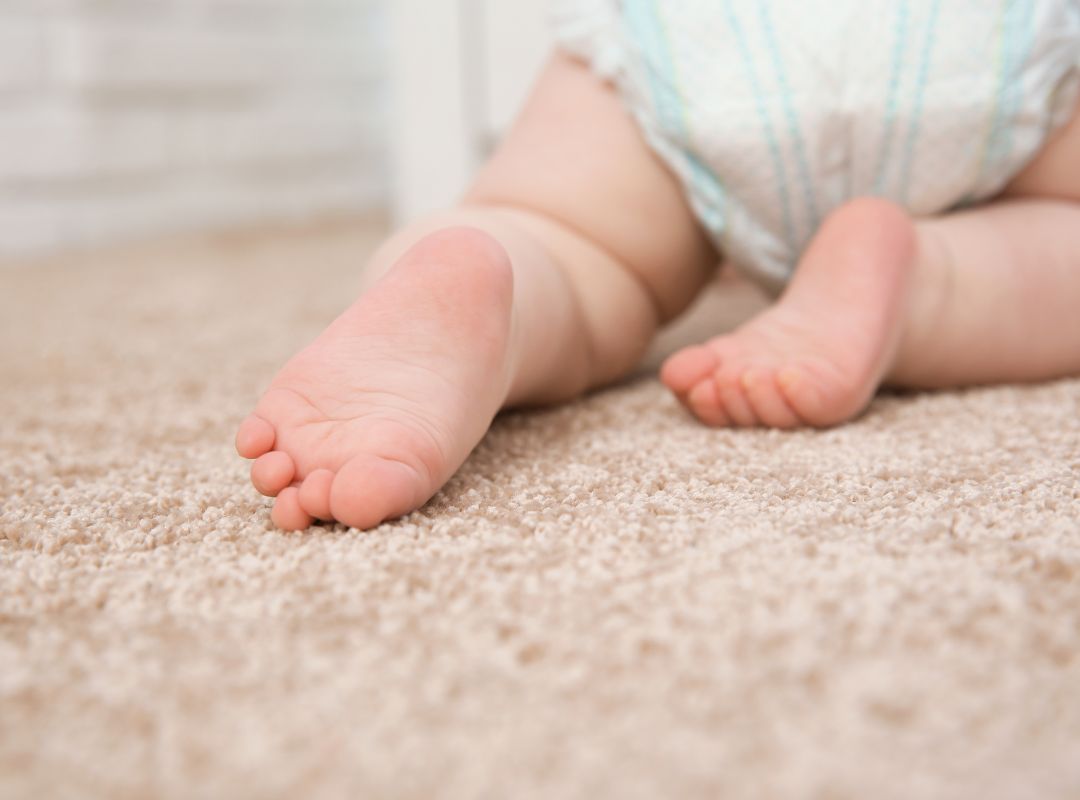
As first-time parents, my wife and I were concerned that our daughter wasn’t crawling yet. She was 7 months old but couldn’t quite get the mechanics down. We didn’t know what to do or how we could help her, but then, on a long road trip—our first as a family—we found our answer. For better or for worse, the answer was a smartphone.
Our daughter Maeve was wailing in the car as babies do, and we’d already tried everything else, so we turned to the one thing we were certain would help: Moana. For the last full hour of the car ride, Maeve sat, contented, not sleeping but no longer fussing, listening to How Far I’ll Go over and over again.
We arrived at our destination, grateful for what we called Maeve’s “Moana trance” that we did it: we upended all our beliefs and rules about introducing smartphone technology to our child…and used Moana, once again, to help Maeve finally learn to crawl.
My wife took out her phone, found our family’s new favorite song, and placed her phone down, face up, ten feet or so away from Maeve. Then pressed play.
I’ve been staring at the edge of the water
As long as I can remember
Never really knowing why.
Maeve was enrapt. On her hands and knees, staring ahead. Moana continued… then it happened. She took off. Maeve wasn’t just crawling; she was now a professional, crawling with such intention and intensity that it seemed she’d never not known how to crawl. But was using the smartphone to motivate her a mistake?
Related Stories:
- I Parented Without Social Media for a Week—Here’s How It Went
- They’re Not Going Away—Here Are the Positive Ways I’m Using Screens With My Kids
A smartphone helped her meet a milestone
All the stages of early parenthood seem to work the same way. Learning to crawl, walk, bike—you name it. You look up and suddenly your baby can do the thing you thought they might never be able to. And then, just as they accomplish it, and your relief and elation apex, a subtle grief creeps in, grief over the time you’ll never get back and the chapter now closed.
But this time was different. This time, another feeling crept in: shame. Shame and worry over using our smartphones as her reward for reaching this important milestone.
To this day, three and a half years later, I still don’t know: did we do something wrong? Did we start Maeve down a path to getting as hooked on this device as her parents—and seemingly everyone else—have gotten? Did we harm her in the process of trying to help her?
Only time will tell. But I have good reason to believe that, if it wasn’t then, it would have happened anyway. She would have crawled. And, yes, she would have come to fawn over the someday-infamous smartphone. The question that matters, though, is “when?”
Babies and toddlers love a smartphone
This wasn’t the first time we felt these kinds of concerns. Even though Moana was as soothing to my daughter in those days as being nursed or rocked to sleep, I don’t think the music would have held the same appeal for her were it not for the fact that it was coming from our smartphones.
Even within the first few months of her life, we noticed that our smartphones captivated our daughter in a way that no other toy could.
And this has never waned since. Today, if my wife or I were to leave one of our phones in a room with our kids (we now have two), they’ll make a beeline for it and try desperately to cling to it when we inevitably go to snatch it back.
That’s what I’m afraid of. Not simply because of what smartphone appeal means for them now, but what it very well could mean for them later.
Avoiding early access to smartphones
Since its release last year, NYU Professor Jonathan Haidt’s The Anxious Generation—a book about the dangers that screentime and social media have on our kids’ mental health—has featured on the New York Times Bestseller list for 76 weeks in a row.
It’s no secret why.
The book cites many studies about the insidious dangers lurking in these technologies, showing how they encourage compulsive behavior, reduce social and emotional intelligence by a device’s mere presence, erode cognitive capacity, and cause depression and anxiety in very clear and harmful ways.
Smartphones change how we parent. They change how we make friends. How we act, think, and feel. And the important part: they do so almost immediately upon using them.
Which is why my wife and I were initially so reluctant to even use our smartphones in our child’s presence. Then came the car meltdown and the crawling concerns, and we were stuck confronting difficult questions about what the science says, and how we were going to deal with the reality that these ever-present devices represent potential harm to our children.
“My wife and I were initially so reluctant to even use our smartphones in our child’s presence. Then came the car meltdown and the crawling concerns, and we were stuck confronting difficult questions.”
Because even though my toddler isn’t exactly asking for her own smartphone, I still get the feeling that she’s being affected just by being around them, and by learning how to operate them in the few moments she has alone with them, or even by witnessing us using them.
Most pressing of all, I fear that we’ve laid the groundwork for her eventual addiction simply by allowing as much exposure to these devices as we have.
Our smartphones are designed to be addictive
Nir Eyal wrote the book on how phones command our attention back in 2013—aptly titled Hooked. It’s essentially a playbook for how companies and developers can design apps that get users’ attention and keep it. Almost every app today leverages the principles laid out in his book, based on human psychology, but more specifically, on the psychology of addiction.
So it makes sense why our phone addiction is so hard to break—but I believe it represents our greatest opportunity to fight back. We need to be honest and assess how we are using our devices. Then acknowledge the difference between essential usage and, well, usage that would constitute our own addictions.
“It makes sense why our phone addiction is so hard to break—but I believe it represents our greatest opportunity to fight back.”
For parents, it’s as old as time: we’re asking our kids to do as we say, not as we do. The difference now is that all of us, young and old alike, are working against a new threat designed to keep us hooked.

How I’m reducing my phone usage, especially around my toddlers
But parents are trying. While we await society to wake up to these problems and our leaders to offer real, lasting solutions, we can do something about it. My wife and I are working towards reducing our smartphone usage…especially in the presence of our kids. Here’s how:
Using our phones like a landline
To do this, we recently instituted a “to-go” policy for our mobile phones. So when we’re at home, for as long as we’re at home, we place each of our phones in a centralized box, similar to a landline.
We’ve already seen positive results
Our new rule hasn’t been in place for long, but we’re already seeing the differences our change has had on us. We’re improving the relationship we have with our devices, but more importantly, we’re avoiding them from getting in the way of our relationship with our kids.
“Technoference” describes the moment we shoo our kids away or otherwise ignore them to keep staring at our phones. When this happens in our house, our tempers are often short; we feel like our kids should recognize our busyness and find independent play more appealing in that moment.
Thankfully, we’ve learned. Children don’t just feel momentarily lonely when rebuffed; they are hurt, and these feelings of hurt linger, and the more often they feel these feelings, the more desperate and clingy they get, desperate for the protection we as parents are responsible for providing them, which is emotional as much as it is physical.
It’s time to take back their attention. And to start, that means by giving them ours.
Final thoughts on toddlers, kids, and smartphones
Nir Eyal wrote a book and launched a career in 2013 to hook people on digital products. Just six years later, in 2019, he wrote a follow-up to that book. The theme of this one? To save us from our screen addictions.
Here’s to hoping we can all listen to the voice inside, like Moana’s Grandma Tala says, and model the phone use we want for our kids to live the life that’s more freely ours.

Matthew R. O’Brien, Contributing Writer
Matt is a freelance writer who spends the majority of his working days producing software for NASA’s Earth Science Data Systems Program, and is a husband and dad to two. Ever the multipotentialite, Matt’s interests vary widely, from watching and playing almost every sport or physical activity imaginable, to reading philosophy, self-help, and fantasy books, to even honing his set at DC area stand-up comedy clubs. Matt loves to nerd out on language, having studied linguistics and English grammar in college, and has parlayed this passion into a part-time writing consulting company called Matterwords.
