


On my son’s fourth birthday, I was waiting for my husband and our two oldest kids to get home from the playground when an unfamiliar Ohio number showed up on my phone. I ignored the call. The number appeared again a minute later, and again, I ignored it. Ninety-eight percent of calls I get on my phone are spam or telemarketers, and 100 percent of my friends and family know I do not like talking on the phone.
Moments later, I heard some commotion downstairs. My mother lives in an in-law apartment on the bottom floor of our home and came running up to me in a panic, phone to her ear. There had been an accident, she said. My husband was injured. He was conscious, but couldn’t move his legs.
She was on the phone with our next-door neighbor. I knew he was originally from Ohio, and it suddenly clicked that it had been his calls I’d declined. He happened to be at the park where my husband had taken our two older kids to blow off some steam before we had dinner and birthday cake. I had stayed home with our newborn.
I sprinted out to my car with my sister, who was visiting, and my mom stayed behind with the baby. It began to rain as I drove up the hill toward the park, but I barely noticed. My mind was reeling. I knew my kids liked to cool off in a creek near the playground, and I imagined my husband slipping in the water and cracking his spine. Was he paralyzed?
Related Stories:
- I Lost My Home in a Fire—Here’s What the Experience Taught Me
- Why Your Kid Keeps Talking About a Scary Experience—And How to Help
Seeing my family surrounded by emergency vehicles
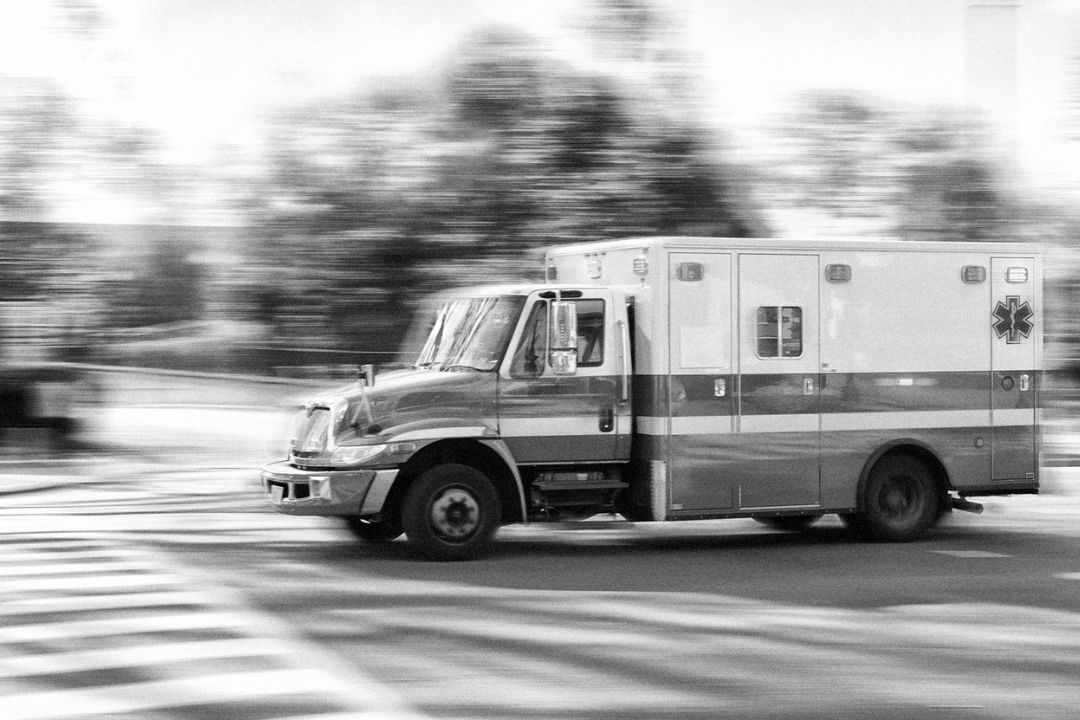
We raced up the hill in the rain. As we turned into the playground parking lot, we found it littered with emergency vehicles. I threw the car into park and jumped out, running toward the crowds of police and firefighters and EMTs. Up ahead, I saw my two kids, shivering in their swimsuits, one in each arm of a paramedic. My daughter was crying and upset, but my son was quieter. It seemed like he was in shock or something, and a little out of it. I grabbed them both and held them tight.
Next, I spotted my husband stretched out on a gurney. He was conscious and talking, though it was hard to tell if he was able to move his legs. I tried to comfort my children as the emergency workers lifted my husband into an ambulance. The whole scene was chaotic and disorienting, and no one was explaining to me what had happened. My son was still in my arms, softly whimpering—as if I was hurting him—and my daughter was next to me, crying. My husband tried to get up to help us, but was warned against moving by the paramedics. I noticed that his T-shirt had been cut jaggedly down the middle. Across his chest were injuries I couldn’t identify. “We’ve got to go,” one paramedic said. “These burns are spreading.”
Burns?
Suddenly, more paramedics were surrounding me, telling me that my children needed to be examined. I was so confused. Had they fallen too? Then, finally, I got an explanation. My husband and my children had been struck by lightning.
Trying to stay calm for my kids
I had to leave the ambulance my husband was in when the paramedics loaded my son and my 7-year-old daughter into another ambulance. An EMT examined my son first, looking him over for any signs of injury. The moment she leaned him forward to get a better look at his back, she startled. My heart dropped as I met her gaze. All across my son’s skin was an intricate pattern of red lines, branching out in every direction. I later learned that this is a burn pattern called a Lichtenberg figure, which appears when the electrical current from a lightning strike bursts the capillaries under the skin. The paramedic spoke, but to her partner in the ambulance, not to me. “We need to get him to the hospital. Now,” she said.
My daughter was still next to me, but now they were informing me that she would need to be put into yet another ambulance. I would have to decide if I would stay with my son or ride with my daughter. I was dumbfounded. It seemed like my son was the one with the more severe injuries. What if I left him and the unthinkable happened on the way to the hospital? What if the last thing I did was leave him alone and afraid with a bunch of paramedics?
Coping with mom guilt in the moment
Fragments of a TV series about a couple who lost their toddler son flashed before me. The boy had an accident, seemed fine and alert in the aftermath, and died suddenly hours later. What if lightning strikes were like that? Was he only conscious and talking now because the full impact of being electrocuted hadn’t taken effect? What if the last thing my son ever saw me do was leave him? But my daughter was still hysterical next to me. How could I send her off into an ambulance alone? I knew they’d have to literally pry her away from me, screaming.
“Was he only conscious and talking now because the full impact of being electrocuted hadn’t taken effect? What if the last thing my son ever saw me do was leave him?”
Suddenly, my sister appeared. In the chaos, I had forgotten she’d come with me. Thank God, I thought. I will be forever grateful that my sister insisted on coming along—now she could stay with my son. Even though I was terrified to leave him, he would at least have someone there whom he loved. I knew my daughter would be more traumatized to be separated from me.
I kissed my baby boy and hugged him, and told him I would see him in a few minutes at the hospital. Then I scooped up my daughter and transferred her to a third ambulance. I didn’t spot any of those horrible spidery burns on her, but she did have a gash in the back of her head. It looked pretty minor to me, but the paramedics weren’t saying anything definitive about her condition.
Riding in an ambulance to the hospital
“Medium rare,” the paramedic tending to my daughter said cryptically to the ambulance driver. I immediately understood this to be a reference to speed. Medium-rare, like medium-fast? I still don’t know if my interpretation was correct—if the paramedics had some shared language to communicate without causing a panic. But as we sped toward the hospital, my panic continued to escalate. “Mommy, why do you look scared?” my daughter asked me. In an attempt to reassure her, I said I was scared, but also relieved that we were on our way to get help. I told her that she would be just fine.
“‘Mommy, why do you look scared?’ my daughter asked me. In an attempt to reassure her, I said I was scared, but also relieved that we were on our way to get help.”
Arriving at the hospital with my family
When we arrived at the hospital, the ER felt just as chaotic as that playground parking lot. I spotted my sister and my son down the hall ahead of us. I breathed a sigh of relief that they didn’t seem to be rushing too much. If his condition was perilous, I told myself, they’d want to get him up to the children’s ER to be treated as soon as possible.
As a paramedic wheeled my daughter down the hallway, she pointed to a set of doors and told me that’s where they had taken my husband. I wanted to look in to see how he was doing, but I couldn’t leave my daughter’s side. I also didn’t want her to be frightened by whatever we might find behind that door. Instead, we proceeded toward the elevator.
On the children’s floor, things finally began to calm down. My daughter and son were put into different rooms. Luckily, they were right next door to one another, so I could easily go back and forth between the two. Though my son still seemed out of sorts, he was conscious and talking, which gave me the reassurance I needed. My daughter seemed even better—chatting the ear off a nurse, which was just like her. I stood for a second to breathe. It felt like things were going to be okay.
“I stood for a second to breathe. It felt like things were going to be okay.”
Spending hours in the emergency room
We spent several hours in the ER while they ran tests on my children. The biggest concern seemed to be for how all that electricity might have impacted their hearts. The ER staff was wonderful. My daughter’s head wound was minor enough that she didn’t need stitches. But when she relayed the story of what happened, she said she “woke up” to see Daddy lying on the ground. Maybe she had lost consciousness? There would be neurological testing done, too. My son’s burns were still etched in my mind, but the ER staff began to reassure me that the tests were coming back looking good. It seemed like my children were not physically in danger anymore.
I got word from one of the nurses that my husband had been transferred to the burn unit on another floor, and that I could visit him while he rested. I left my kids with my sister to go and check in on their dad. When I got there, he was lying in his hospital bed with a brace around his neck. It was just a precaution, though. He had regained use of his legs, but they wanted to keep him still. He asked about the kids, and I relayed what I remembered of the results of their testing. After a sigh of relief, he began to tell me the story of what had happened.

What actually happened with the lightning strike
They had been playing around in the creek until it was time to leave and head home, but as they walked to the parking lot, they noticed a storm brewing off in the distance. It wasn’t raining in the park, so they decided to stay and watch for a minute. They sat on a big rock, my son in my husband’s arms, my daughter sitting next to them. Because the lightning was still far in the distance, my husband didn’t imagine they were in danger. They weren’t sitting near any trees or water, and there were still people playing on the playground. But suddenly there was a loud noise and everything went dark.
My husband said he didn’t lose consciousness, but he couldn’t move. Worse, he didn’t hear the kids. As he told me this part of the story, he broke down in sobs. I could practically feel the cold, white terror in his voice. He couldn’t move to reach for our children, he told me. And for a few excruciating seconds, he didn’t know if they had survived. But suddenly, thankfully, they both started screaming, and our neighbor approached to help while they waited for emergency workers to arrive.
The rarity of being struck by lightning
My husband had some soreness from the burns, but he was in much better shape than I expected of someone struck by lightning. I would have guessed that something like that killed you on the spot. But it turns out, according to the Centers for Disease Control, nearly 90 percent of people struck by lightning survive. Still, it’s an incredibly rare event—the odds of being struck are less than one in a million. My husband joked about beating those odds, saying he should probably go ahead and play the lottery. After a short visit, I returned to the children’s ER to be with my kids. My husband bought two lotto tickets from his hospital bed. He didn’t win anything.
“Nearly 90 percent of people struck by lightning survive. Still, it’s an incredibly rare event—the odds of being struck are less than one in a million.”
The doctors eventually transferred us to the children’s hospital and told us the kids would have to be monitored overnight. The novelty of a hospital stay temporarily launched the kids into hyperactive mode, though the late hour and the unimaginable experience of being electrocuted should have left them completely depleted. It was closer to dawn than dusk when I finally kissed their sleeping heads and curled up on a hard leather sofa. I spent the rest of that night frantically Googling lightning strikes.
Preparing for PTSD after a traumatic event
The next day, all kinds of doctors and medical staff stopped by to talk to me and my kids. They warned us that an experience like this could result in PTSD. I should expect to see some acting out from both my son and daughter in the near future. They gave us a children’s book that might help address their fears: Right Now, I am Fine, by Dr. Daniela Owen. It included simple descriptions of fear and anxiety, and ideas for getting through episodes of panic. The book explained that sometimes bad things happened in life that were very scary, but it wasn’t specific. I asked the doctors and social worker for information about the long-term effects of a lightning strike, but no one offered me any clear answers.
The kids would definitely have to have follow-up visits with various doctors, but apart from that, they didn’t know what might be in store for the kids. In the months since the incident, I’ve struggled to dig up much information about the long-term side effects of getting struck by lightning. I did find an abstract for one study on the National Institutes of Health website that said none of the lightning strike patients showed any long-term problems that could be definitively connected back to the strike. This was encouraging, but that study was based on only 12 patients. That didn’t seem like a very reliable sample to me.
Coming home and trying to project normalcy
My whole family was discharged from the hospital that day. I was reunited with my infant and couldn’t shake the knowledge that this accident could have cost us our entire family. I held her tight, and my husband and I did our best to project calmness and normalcy for our older children.
“I couldn’t shake the knowledge that this accident could have cost us our entire family.”
We would learn that it was the rock where my husband and kids had been sitting that had actually been struck, suddenly and mysteriously, before the rain even came. My husband had absorbed the bulk of the strike, and because he’d been holding my son, had passed the electric current right through our little boy. My daughter had probably not absorbed much electricity, but the strike had sent her flying off the rock like the other two, and she’d hit her head in the fall.
By the time they discharged us, my son’s spidery burns had faded so faintly that my camera couldn’t pick them up. We did take pictures of my husband’s injuries, mostly first-degree burns with some spots of second-degree burns. The burns formed a path that the electric current had taken across my husband’s body. It crawled up the back of both his legs, along a path of singed hair, through his groin and chest, where they disappeared into his left armpit. Right where my little boy had been.
Investigating the incident
A few days later, we were all emotionally drained, but everyone seemed to be doing well physically. My husband set off to investigate the scene of the accident. He noticed a flagpole next to the parking lot, and we still wonder to this day what strange mix of fate and science made the lightning strike that rock instead of the metal rod right nearby that rose high above everything else around it. The rock itself was still mostly intact, with a large chunk visibly chipped away. Splashed across the top was a glittering metallic substance that reminded me of dried paint. My husband reached out to his geologist friend, who told him the substance was fulgurite—also known as “fossilized lightning”—and is sometimes produced when lightning strikes rock.
Before he left the park that day, my husband spotted a security camera attached to a building across the parking lot from the scene of the lightning strike. It might have been too far away to capture much of anything, he thought, but he decided to reach out to the parks department to see if they could share the footage.
Reflecting on the aftermath of a traumatic event
It has been more than six months since the lightning strike, and so far, there is very little evidence that my husband or children have suffered long-term side effects. My husband’s burns required some care early on, but neither he nor my son has any scarring. In the early days after the accident, the kids had some meltdowns, but none that felt especially worrisome compared to their typical behavior.
The one thing that has lingered has been their fear of rainstorms, especially for my son. But mostly, when the rain does come, they just want some extra cuddles and attention. One night over the summer, my husband and I were up late watching TV when a thunderstorm rolled in. A huge crack of thunder sounded, and we both automatically jumped from our seats and ran upstairs to comfort the kids. But we found them just as we had left them, sound asleep in bed.
Becoming temporary neighborhood celebrities
My family’s experience was quite a hot topic in the neighborhood for a while. People were horrified but curious, too. The kids loved their little taste of celebrity and told anyone who asked (and many who didn’t) what had happened to them.
I did get a call from the school nurse, saying that my daughter came into the office complaining of various ailments, including being struck by lightning. I could tell the nurse was trying to hold back a chuckle. She didn’t want to embarrass my daughter, who was obviously within earshot, but she was wordlessly sending me a wink at my daughter’s overactive imagination. “Well, actually, that part’s true,” I told her. She immediately went silent and then launched into professional mode. “We are going to need to include that with her medical information,” the nurse told me.
Feeling grateful, but knowing safety is fragile
It’s hard for me to articulate, or even identify, the effect this incident had on me emotionally. I’ve become more cautious when the forecast calls for rain, but that is a preemptive reaction to my children’s fear as much as my own.
Looking back, I’m surprised I managed to stay relatively calm in that parking lot and at the hospital. The only other serious accident I’ve experienced with one of my kids was when a heavy door fell on my son, slicing open the back of his head. He needed staples for that, and I spent hours in the ER with him waiting for treatment. I felt terrible for him and wished only to comfort him through the fear and pain. But I was also very aware the whole time that this was part of motherhood. My kids are very curious and not terribly cautious, so chances are it won’t be the last injury I have to live through.
A lightning strike was not something I ever imagined happening to my family, but seeing them awake and talking minutes after it happened probably helped to ease my panic. I couldn’t freak out—I needed to put on a brave face for my children, who didn’t need to feel my anxiety secondhand after experiencing something so frightening themselves. I see this as a good thing, but there’s also the lingering notion that horrible things happen to people without any warning or explanation. The people I love are not as invincible as I wish them to be.
“I couldn’t freak out—I needed to put on a brave face for my children, who didn’t need to feel my anxiety secondhand after experiencing something so frightening themselves.”
Now, when I’m at the end of my rope with my kids (we’ve all been there), I pause and remember how lucky I am that this freak accident didn’t turn out more catastrophic. It easily could have.
Many weeks passed after my husband inquired about the surveillance video footage before the parks department finally shared it with him. You can’t see the rock, and my husband and children are blocked from sight by the few vehicles still parked in the playground parking lot. The video is soundless, and the seconds tick away gently. But then, in a flash, a bright white line of electricity shoots down the frame and disappears behind those idle cars, where my family sits, watching the sky.

Megan Pareja, Contributing Writer
Megan Pareja moved back to her hometown in Upstate New York to teach middle school English and raise a family. She has a BA in English from Trinity Washington University and a master’s degree in secondary education from UMass Amherst. She lives with her husband and their three children in her childhood home, where they enjoy hosting Friday night pizza parties and family movie nights—popcorn mandatory. Before teaching, Megan worked as a newspaper reporter on Martha’s Vineyard and in Oak Park, IL.
