


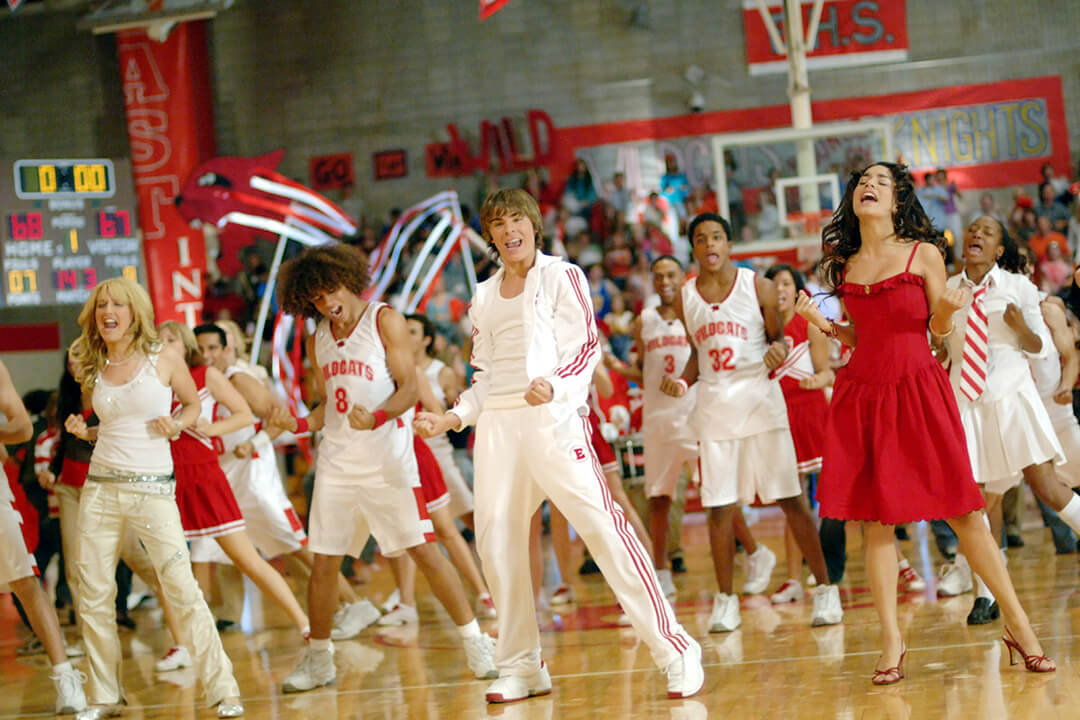
What do you do when you get hit by a massive snowstorm while solo parenting two kids who are home from school for a full week…and it all just so happens to coincide with the 20th anniversary of High School Musical?
Well, if you’re anything like me—a hopelessly nostalgic millennial mom and musical theater lover who also happens to be doing everything in her power to instill a love of musicals in her own kids—you have a HSM marathon. And you realize that revisiting the franchise as a mom doesn’t just scratch the nostalgia itch; it also holds up in some unexpected ways.
Twenty years after its premiere, High School Musical certainly feels dated. But is it worth the watch? I say yes, if you’re looking for a family movie. And my take? This franchise also has some really valuable lessons for kids today.
You May Also Like:
- 60+ of the Best Early 2000s Kids Movies to Stream Now
- From Vanessa Hudgens to Olivia Rodrigo—Why It Mattered for Little Girls Like Me to See Themselves as the Main Character
Watching High School Musical then
But before we get to what those lessons are, let’s take a step back. We millennials grew up in the age of pop culture that envisioned teens in a very specific way: There were the cool kids, the nerds, the jocks, the theater freaks…you get the picture. Rarely did movies show the interplay between those worlds. Sure, we’d get the nerdy girl who removed her classes and gained instant popularity (this is the whole plot of She’s All That, no?), but even those narratives taught us that there’s one way to fit in, or, to put it in High School Musical’s terms, “stick to the status quo”.
Twenty years ago, in January 2006, High School Musical dared to reimagine that. The movie, in case you need a refresher, feels like a wholesome aughts-era take on Grease: Basketball star boy meets math nerd girl on their respective family vacations. They sing a song together, forge a connection, see a talent in one another, and discover they both love to sing. When the school year begins, the boy is shocked to learn that the girl has transferred to his school. They exist in different worlds within the context of that high school, though.
And the school musical exists in another world entirely, one they both feel they have no business stepping into—even though they both really want to. The plot line of the first High School Musical is delightfully simple: Troy Bolton and Gabriella Montez fight against the rules of high school to audition for the school musical and date each other. The biggest hurdle in their way? The “status quo”, which demands teens stick to the stuff they know. In Troy’s case, that’s basketball and generally just being a popular jock; in Gabriella’s, it’s academia.
Watching High School Musical with my kids now
I’m a mom of kids in elementary school. They don’t know terms like “jock” and “nerd”, and they’re not explicitly thinking about being “popular”. But they’ve already started to absorb messages about what they “should” be doing, and watching High School Musical with them gave me a vehicle to open up conversations about this central theme.
Lessons from High School Musical for my son
Take Troy Bolton, the male lead of High School Musical. Like my own son, he’s athletic and loves sports, but there’s more to him than that. That’s the type of example I want for my own child: The idea that he can do the things that aren’t traditionally “masculine”, like dance, sing, and draw.
A few weeks ago, my husband and I agreed it would be good for our son to get involved in a non-sports activity. When we presented that idea to him, he was hesitant. After watching High School Musical and seeing that Troy could be both a basketball star and a singer, he seems to be softening to the idea. Troy walked so Glee’s Finn Hudson could run: Both iconic male leads reimagined the jock trope and put a healthier standard of masculinity in place. That’s a valuable role model for our sons, and in a world of red pill-ing and toxic masculinity, that feels really important.
Lessons from High School Musical for my daughter
And then there’s Gabriella Montez, High School Musical’s female lead. Watching her overcome her stage fright and the expectations people place on her has opened up learning lessons for my own shy daughter, who sings and dances constantly at home but tends to freeze up in front of an audience. After watching, we talked about stage fright and how it’s okay to feel nervous—and also, how rewarding it can feel when you face your fears head-on.
My own little girl, like Gabriella, is interested in musical theater but shied away from it because none of her friends are into the performing arts. Now, High School Musical is doing for her what it did for so many teens 20 years ago: It’s showing her she’s not the only kid who loves performing, even if musical theater isn’t quite as mainstream a hobby as, say, soccer, basketball, or gymnastics.
And listen, it’s not as simple as watching a movie and saying “look, guys! The characters in this movie try things they’re interested in, even if they’re not the ‘cool’ things to do, and you should too!”. My kids aren’t going to become impervious to their peers’ opinions just because they watched High School Musical one time. But it feels like a start (dare I say…the start of something new?).
“My kids aren’t going to become impervious to their peers’ opinions just because they watched High School Musical one time. But it feels like a start (dare I say…the start of something new?).”
Looking back on the High School Musical 20th anniversary
I think the reason this movie was such a massive hit—despite feeling a bit low-budget and starring a cast of virtually unknown actors (at the time!)—is that so many kids and teens felt seen by the premise. The idea that they too could step outside the lines and be more than one thing, hold more than one interest, spoke to young viewers 20 years ago, and that’s relevant today.
There’s something so approachable about the High School Musical universe: It doesn’t pretend insecurities and social pressures don’t exist, it normalizes the feelings so many kids face as they work to figure out who they are and where they belong. And it also sends them a message: It’s okay to be more than one thing, to belong in more than one world.
In a media landscape that often portrays high school students as perfectly groomed, incredibly precocious, and well aware of their place in the social stratosphere, High School Musical allowed teens to be…kids. Kids who are awkward, youthful, and very much in the process of figuring it all out. The franchise tapped into this powerful piece of childhood and the teen years. And regardless of how much has changed in the world, especially as it relates to childhood and adolescence in the past 20 years, that feels universal, even a generation later.

Zara Hanawalt, Contributing Writer
Zara is a twin mom and freelance journalist with over a decade of experience covering parenting, women’s health, and culture. In addition to The Everymom, she’s written for outlets like Vogue, Marie Claire, Glamour, Cosmopolitan, Parents, Shape, Motherly, The New York Times for Kids, What to Expect, and many others. In her spare time, she enjoys reading, cooking, travel, watching TV, and trying new restaurants.
