


Last year, I went to a meeting with a few dozen parents from my youngest daughter’s third-grade class. All parents had signed a pledge not to give our kids smartphones until high school and social media until age 16. The meeting was to connect and brainstorm ways to support each other, to affect no-phone policies at our schools, and more. It felt like a convergence of shared purpose that gave me hope after being jarred by Adolescence on Netflix and Jonathon Haidt’s book The Anxious Generation. As one mom said in the meeting, “it feels like a freight train is heading for my family and I need to do something about it.”
I agreed and felt hopeful to be part of a group of parents with the same concerns. And we’re not alone. With parent-led organizations at the forefront of the phone-free school movement, more and more states across the country are banning phones (and other internet-connected devices) in schools, including the largest U.S. school district in the country: New York City. While NYC students don’t start school until September, cell phone bans in schools in other states have already started—with initial positive feedback from teachers. But not everyone is for the bans. The president of the National Parents Union recently wrote a USA Today op-ed against the bans.
As this back-to-school season begins, it feels like we are in the middle of important educational changes that are destined to be a little messy as we figure out what’s best for our kids. Keep reading for more reactions from teachers, parents, and students—including whether there are any potential downsides to cell phone bans in schools.
Which states have school cell phone bans?
So far, 14 states have banned cell phones during the school day, including:
- Alabama
- Florida
- Georgia
- Indiana
- Kentucky
- Louisiana
- New York
- North Dakota
- Oklahoma
- South Carolina
- Tennessee
- Utah
- Virginia
- West Virginia
There are often some exceptions from the cell phone ban, including students with medical conditions that require monitoring, students who need translation services, if the device is required by an Individualized Education Program (IEP), and more. Several additional states have guidelines and policies to help schools decrease school day phone usage.
Why ban cell phones in schools?
The reason to ban cell phones in schools seems pretty obvious: eliminate distractions, refocus on learning, and improve interpersonal skills. Not to mention a potential decrease in cyberbullying.
New York Governor Kathy Hochul said in a statement about her state’s ban, “Our kids are overwhelmed by the addictive algorithms and endless distractions. Ninety-five percent of teenagers have smartphones. They receive 250 notifications a day on average. They can’t possibly focus on anything else… I want our kids to make eye-to-eye contact again. I want them to enjoy the experience of real human connection, not just through a screen… And we want our teachers to feel liberated to teach again.”
Teachers commenting on social media shared that, without a law, phone bans can be difficult to enforce, and many remained cautiously optimistic—and hopeful that parents will support them.
“I personally try my best to eliminate the problem, but there’s no consistency between teachers, so any regulation ends up fought at every turn… My state just banned cellphones and the district surprisingly made a very strict policy with actual consequences that all teachers and admin have to follow. I’m very cautiously excited to see how this goes,” wrote reddit user @king063.
“As a teacher… I also think parents need to help back us more by having consequences for kids who have their phone out during instructional time,” commented Kayla Madden on TikTok.
Teachers react to cell phone bans in schools
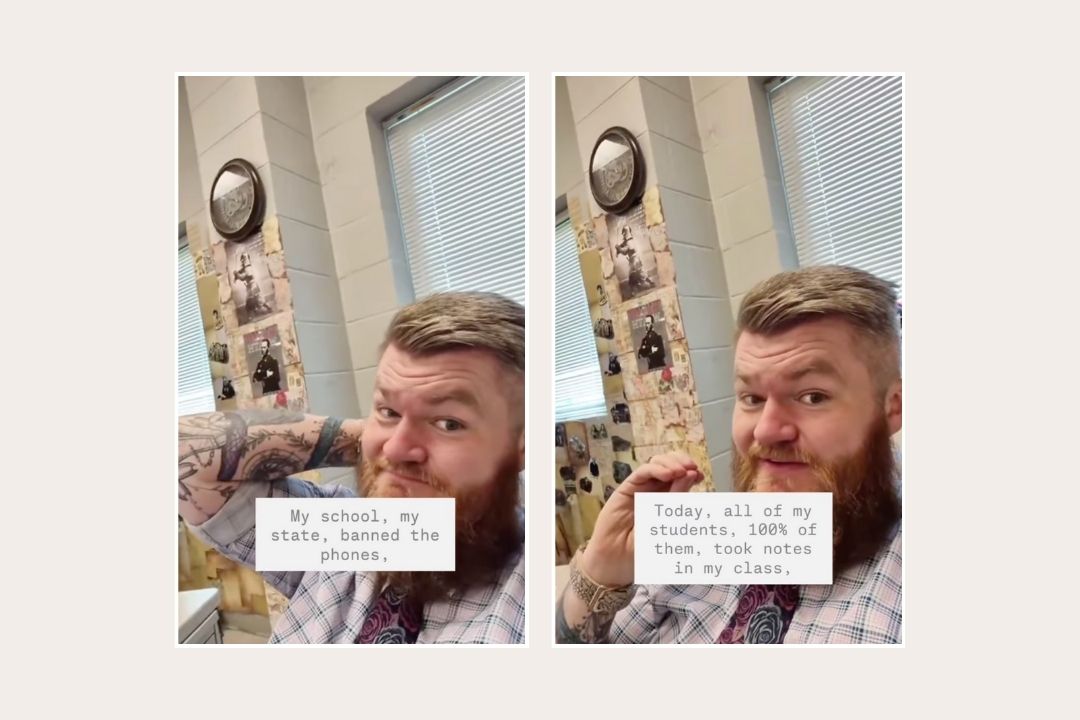
Alabama social studies teacher Jonathan Buchwalder (@jonstertruck) recently shared his experience in a now-viral TikTok, with Anxious Generation author Haidt amplifying his initial post on Instagram. “[Have phone bans] been this easy of a solution the whole time?” Buchwalder asked after mentioning his students took notes and actually talked to each other in the classroom without access to their phones. He even posted a follow-up video that said the lunch room is louder, the library is busier, and behavior issues have gone down since the school’s cell phone ban went into effect.
More reactions from teachers
More teachers chimed in with comments on Buchwalder’s video and additionally shared comments on reddit, Threads, TikTok, and Instagram.
“Teacher here: no phones this past year led to more socializing between students and it was so good for their mental health. Before the phone ban, class would be silent during passing periods and it was so sad,” wrote @heidi_marie_b on Threads.
“Another teacher said kids were passing notes to each other in class instead of texting each other. It’s beautiful 🥹,” wrote @n03t on TikTok.
“The benefits of them being phone-free so enormously outweigh the minor inconvenience of facilitating a phone call. My students can call their parents whenever they want. I look up their parents’ numbers if they don’t know it and give them the space they need to have a private conversation. But what I don’t get is why parents need to contact their kids all day… What is so important that you’re willing to disrupt your child’s learning?” wrote @hannahrsmackie on Threads.
“My freshmen classes have done so well this week! Behavior has been off-the-charts wonderful, and they have remained on task so much better than in the past. Parents I’ve talked to have been on [board] when I tell them I will only take phones if it becomes a problem. We need parent support,” wrote @nisiebug21 on Threads.
While some commenters suggested this could be a “honeymoon phase,” teachers shared what a year without phones could look like. “Yep, my school banned them last year. It was amazing. I could actually teach without the ‘put it away’ every 60 seconds AND so much less social drama because of it,” wrote @bubsistheword on TikTok.
Parents’ reactions to phone-free schools—positive and negative
Not everyone is happy about the bans, with one parent’s comment going viral on Threads with thousands of comments, “How do y’all feel about the no cellphone policy in schools? I understand where they [are] trying to go with this but, as a parent, I need my child to be able to contact me at any given time 😒.” Their comment highlights a finding from a recent poll by the National Parents Union: 76 percent of parents who responded send their kid to school with a phone, citing safety as the number one concern.
“I was in school during [the Columbine shooting]… My kid will have their phone. If it becomes a problem and they can’t just leave it in their pocket during class, then it can be a discussion. But no, they’ll have their phone,” wrote @katylynne on TikTok.
At the same time, other parents don’t understand why parents are interrupting their kids’ learning. “As a parent, I don’t need my child to be able to contact me at any time. In fact, I see way too many parents and children unable to adjust to college and independent life, and I’m starting to think this is part of the problem,” wrote @artsie126 on Threads.
“I don’t get the pushback at all. Phone use in schools was just recently banned in my state, and parents were losing their minds. Like, why? I think it’s great! You can’t control what other parents allow their kids to bring to school, and you can’t fight single-handedly against [what] the internet has to offer, nor the long arm of bullying that 24/7 phone access now provides kids of all ages,” wrote @CrustyBubblebrain on reddit.
Students react to cell phone bans in school
A recent Pew Research study found 48 percent of teens believe social media harms people their age. And reporting published in The Australian on August 15, 2025, found kids want to be free of their phone addictions, but don’t know how. Could school phone bans help?
“I’d much prefer the rule of your phone is confiscated until the end of the day if you use it during class instead of a full-on ban. People should be allowed to use their phones in-between classes and I would much rather keep my phone on hand in case of an emergency text,” wrote @fantasy-capsule on reddit.
“My 9th grader said it was so much better. They were actually talking to each other at lunch,” wrote @CajunTexan on TikTok.
”If you need your child to contact you at any given time, then you have completely forgotten how school works. I teach at a middle school that implemented a no cell phone policy last year during class and lunch. Students with medical issues had access if needed. Do you know what the staff found was the result? There was absolutely no pushback from the students! They respected the policy, socialized more, and became more active outside. They had no problem with it!” wrote @lorlam68 on Threads.
How are schools enforcing the phone bans?
Policies and consequences seem to vary by schools, but using New York City as an example, the law states that the policy must include methods for parents/caregivers to contact the student during the school day. And one or more methods for onsite storage—and backpacks don’t count. Here are some solutions schools are introducing:
YONDR pouches
Some school districts are using YONDR pouches as a storage solution, which locks the phone inside a pouch within a “phone-free area,” in this case, school. The phones stay within the student’s possession, but they can’t access it unless they’re outside the zone. Of course, according to some online comments, some kids are finding ways around this by having “burner phones” or other means of opening the pouches.
Parents have taken to TikTok to complain that their school gave them the pouches without direction. Or, in the case of one video, questioning the school spending money on YONDR pouches when the school cafeteria was running out of food to feed the kids. It’s no secret that school budgets are tight, and I understand parents questioning priorities if the students are going hungry.
Yet, teachers chimed in the videos’ comments saying, “The behavior at the school I work at had a dramatic decline in fights, disruptions, and unnecessary bathroom [trips] since they started using them.”
“My school has used Yonder pouches for two years and they have been a game changer! Kids have meaningful conversations and they are more focused on school and not social media. No classroom distractions and no videos or AirDropping inappropriate things,” another teacher noted.
‘Off and Away’ policy
In California, “Off and Away” is a district policy to limit the use of cellphones during the school day. According to a report by ABC News, “At the beginning of every class, students drop the phone into what’s called a “cell phone hotel.”
Other school policies and consequences
More teachers and administrators shared other policies at their schools—from keeping phones in lockers to enforcing disciplinary actions. “Standard policy at schools I’ve worked with is phone stays in your locker, you are not allowed to have it on your person in class and if they see it they confiscate it, end of discussion,” wrote reddit user @Zetavu.
“For over a decade, we have had the rule that phones must be turned off and in backpacks. Teachers can authorize them to turn them on briefly for educational purposes… If a student is caught with a cell phone, it is confiscated until the parent either picks it up or talks to the administration and releases the kid to pick it up. (Also, an automatic Saturday school punishment). The students can whine occasionally, but I never have to compete with cell phones for students’ attention,” wrote reddit user @lumpyjellyflush.
“[Thirty-year] high school teacher here… I’ve been collecting phones before class for seven years… I’ve had a total of two parents complain. In seven years. On parent/teacher night, I have parents thanking me for doing it,” wrote reddit user @Anxious-Raspberry-54.
Is there a downside to phone-free schools?
Some opponents think we should be teaching kids healthy ways to live with phones, versus banning them during school. But the biggest complaints about the bans appear to be coming from parents who want to contact their child at any time during the day, but especially in case of an emergency.
I understand the worry. You can’t be a parent in 2025 and not think about school safety every time you drop your kid off at school. However, to me, it’s a matter of risk assessment. If I’m not able to contact my kids during a lockdown, it feels more important that they listen to their teacher and follow directions to keep them safe in that moment. All other “emergencies” can be handled using the school’s office phone. Teachers echoed this sentiment online.
“As a teacher, I’m going to say this louder for the people in the back: YOUR CHILD CAN USE THE OFFICE PHONE AT ANY GIVEN TIME. Students need to focus in class. Having their phones detracts from their ability to do so,” wrote @erinkimlinger on Threads.
“Parent contact is literally the most common excuse I’m given for why a kid is on their phone. They think they need to know during fifth period who is picking them up after eighth period. No, you can look after the bell rings. If it’s a true emergency, your parent can call the school like they did in the Stone Ages of flip phones,” @Alternative-Movie938 wrote on reddit.
One mom’s thoughts on phone-free schools
This year, my daughter enters seventh grade. She has an Apple Watch, but she is in the minority of peers without a smartphone. The watch stays in “school mode” and is enough to connect her with her friends without unfettered internet access. Although I’m not naive enough to think she doesn’t see things on her friends’ phones. But still, I’m happy we’ve held the line on smartphones ,and if she has to give up her smartwatch during the school day, I fully support it.
And for my younger daughter entering fourth grade, my hope is that more widespread cell phone policies mean *maybe* she won’t be in the minority of peers without a phone by middle school. As researchers have stated, one parent alone can’t make the change if society hasn’t shifted—but phone bans feel like a good start.
Parenting in the digital age is tough and can feel overwhelming. The world is so different from the one we grew up in. We’re watching our kids be the guinea pigs in a world with smartphones, AI, and more while we’re learning the technology alongside them. And phone bans may feel like one more experiment to some parents. But I think a little regulation in the education space feels like one positive step in taking back some of the power we’ve lost to tech—and it might support teachers and our kids in the process.
Related Stories:

Kathy Sisson, Senior Editor
Kathy Sisson has been a key contributor in the editorial parenting space for eight years, not only as a full-time editor at The Everymom but previously as a freelance writer for top parenting sites, including Scary Mommy, Motherly, Parent Co., and more. As an editor at The Everymom, she has produced hundreds of articles on a range of parenting topics, reviewed dozens of family-focused products, interviewed leading experts in the children and parenting world, and created viral parenting social media content. A mom of two, she is committed to sharing the honest, helpful, and often humorous stories of motherhood.
