


My husband and I often joke that we wish we could pick our kids’ friends based on how well we get along with their parents. Occasionally, it all works out. We meet the parents of a kid one of my children has been talking about nonstop, we invite them over, and an instant match is made in friendship heaven.
But more often than not, friendship—like most things in life—gets complicated once motherhood enters the chat. Female friendship is one thing; mom friendship is a whole other: For the latter, so many other things matter, especially today.
Do your partners get along? Do your kids? Are your values similar? Do you keep compatible schedules? Do you live relatively close to one another? Are your kids similar ages and stages? Do you align on household rules? Do you validate each other’s approaches to parenting?
Turning a mom acquaintance into a mom friend is tough. But finding a whole group of fellow moms who check multiple boxes of compatibility? That’s like finding a needle in a haystack.
Related stories:
- How I Dealt With Losing a Mom Friendship
- I’m the Reason I Don’t Have Many Mom Friends—Here’s How I’m Trying to Change
- My Toxic Mom Group Ruined My Baby’s First Year of Life
- I’m Turning 40 This Year—Here’s How I’m Caring for My Friendships Into a New Decade
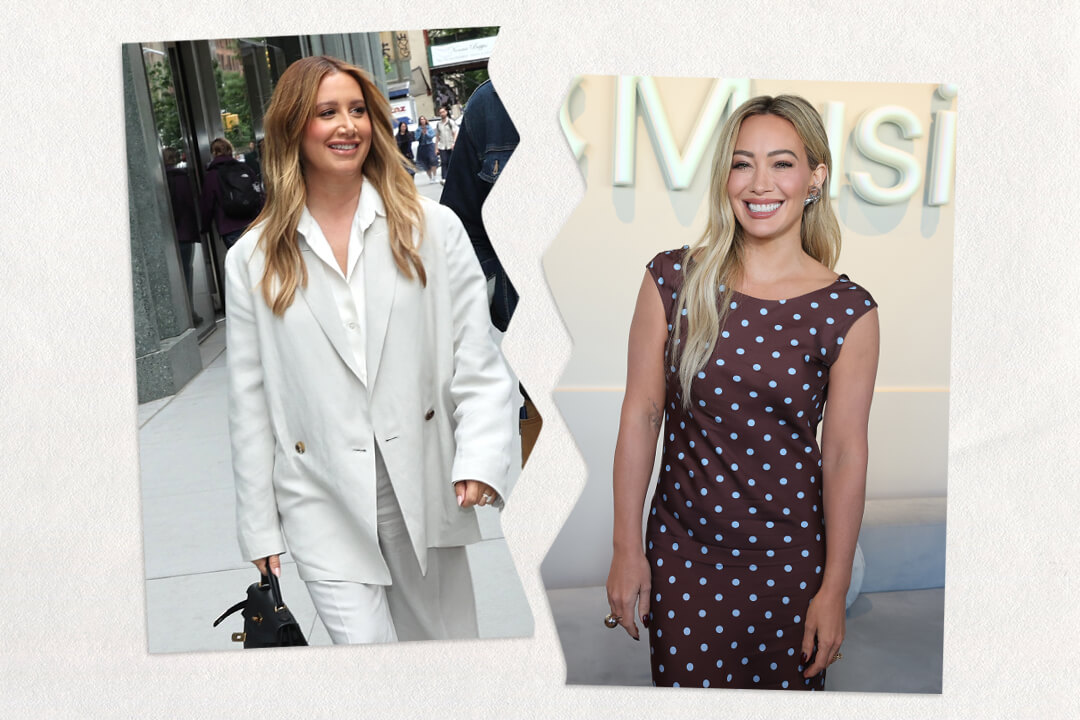
The Ashley Tisdale Hilary Duff toxic mom group drama
That’s part of the reason, I believe, why Ashley Tisdale French’s recent essay about breaking up with her “toxic mom group” went so viral.
I’ll admit it: I’ve dreamed about infiltrating the celebrity mom group that the essay is rumored to be about. Composed of stars like Hilary Duff, Mandy Moore, and Meghan Trainor, these women have always struck me as such a fun, close-knit mom group. For years, when I saw photos of them together, I wondered why I couldn’t find this type of mom group myself. To me, they seemed perfect.
But perfect doesn’t exist. Not in motherhood, and not in mom groups.
I don’t know what really went down in French’s own group, or even if she’s referencing the one everyone believes her story is about (though Duff’s husband all but confirmed the rumors). Here’s what I do know, though: This is much bigger than French’s essay.
We grew up with the female frenemies trope
As a millennial woman, I was practically raised on stories of female frenemies. My generation obsessed over Laguna Beach’s Lauren and Kristin feud, then picked sides when Gossip Girl introduced us to Blair versus Serena. And as we’ve grown, the female frenemy trope has followed along. That’s why we’re so obsessed with shows like The Secret Lives of Mormon Wives and the Real Housewives franchises. Fraught friendships between women are a cultural comfort zone for us.
We’ve been so conditioned to pit women against one another that watching these feuds play out between women feels a little bit addictive. At face value, it reads as very “high school”, but the obsession with female feuds has always been a piece of the motherhood experience. The mommy wars are still alive and well. PTAs are still stereotyped as unwelcoming spaces, and mom groups, both digital and IRL, still earn reputations as being judgmental, catty, and yes, toxic.
“We’ve been so conditioned to pit women against one another that watching these feuds play out between women feels a little bit addictive.”
So when we read a headline like French’s, we latch on to it. It becomes an invitation for us to throw around terms and tropes we’ve watched our whole lives. We decide we’ve earned the right to assign the “mean girl mom” label.
The real challenge of finding mom friends
What if, instead of using this story as proof that mom groups are toxic, that large groups of women are inevitably dramatic and competitive and catty and mean, we use it to look at what we’re truly up against right now?
Building and maintaining a community of mom friends is not easy, and it’s actually never been more complicated. We’re forming these groups all while navigating a divisive political climate, a set of incredibly intensive parenting standards, and a work culture that makes “balancing it all” nearly impossible. And we’re doing it all as messages from social media trickle in: “Set that boundary”. “Protect your energy”. “Go no contact”. “Stop being a people-pleaser”.
We are stretched thin
The emotional load of millennial motherhood is heavy. We’re carrying our kids’ feelings, holding our marriages together, and in many cases, caring for aging parents—all while being told to work harder on ourselves, physically, mentally, professionally, and emotionally as well.
As we millennial moms recalibrate our relationships to our children, our partners, our parents, our work, and ourselves, we’re also rewriting the rules and standards of female friendship. On top of that, we’re also balancing our own loneliness and need for connection alongside our chronic overwhelm and overstimulation.
We still want mom friends
And so we want more mom friends, but we also want time for ourselves. We want moms’ nights out, but we also know we need to carve out time for date nights. Catching up with the mom squad over lunch would be ideal, but we’re also managing deadlines and doctors’ appointments throughout the day. We want to make it to that get-together we planned months ago (we really, really do!), but our kid just started puking, and we have to cancel…again.
The cost of conflict can feel too high
And there’s the tension: We don’t have unlimited energy, so maybe the smallest inconveniences of friendship—the kinds of things we’d be able to shrug off if we lived in a perfect world—do feel too “toxic” to warrant our already dwindling bandwidth and time.
On top of all that, figuring out how to address conflict doesn’t just affect you when you’re a mother. Maybe you love a mom group, but the children of other members are unkind to your own kids, for example. Or, on the flip side, maybe you truly don’t connect with a group of fellow moms, but you stay so your kids won’t be excluded.
Yet we still try to model healthy friendships for our children
As French writes on her own blog, we want to model for our children what it looks like to stand up for yourself, to remove yourself from spaces in which you feel small. But we also want to show them that real friendships are worth the extra effort, and that friction can be handled in a healthy way. It’s a difficult balance…and when you know you’re going to see members of the mom group at drop-off and birthday parties and soccer practice, it all feels so much more delicate.
“We want to show [our kids] that real friendships are worth the extra effort, and that friction can be handled in a healthy way.”
The bottom line? Friendships among moms are complicated. Yet instead of acknowledging that, we are culturally so quick to decide that the moms themselves are the problem.
Did the celebrity mom group drama make us feel seen?
The reaction to French’s essay is proof: We have a real cultural fascination with women feuding, a societal need to pick sides. And I get it: There’s something kind of delicious about this inside look at the real lives of the millennial screen queens many of us grew up idolizing.
But is there something else going on here? Everyone is invested in this drama in such a major way…and I imagine part of it is because moms feel a tiny bit validated to see that even this seemingly perfect mom squad faces shake-ups too.
“I imagine…moms feel a tiny bit validated to see that even this seemingly perfect mom squad faces shake-ups too.”
Sometimes friendships are unhealthy. Some mom groups are more drama than they’re worth. Maybe French’s group was, as she says, truly toxic. But maybe sometimes it’s not about a “toxic mom group” at all—maybe it’s more about all the other stuff that makes building a group of mom friends feel so impossible.

Zara Hanawalt, Contributing Writer
Zara is a twin mom and freelance journalist with over a decade of experience covering parenting, women’s health, and culture. In addition to The Everymom, she’s written for outlets like Vogue, Marie Claire, Glamour, Cosmopolitan, Parents, Shape, Motherly, The New York Times for Kids, What to Expect, and many others. In her spare time, she enjoys reading, cooking, travel, watching TV, and trying new restaurants.
Feature graphic images credited to: Amy Sussman/Getty Images for Apple Music and Jose Perez/Bauer-Griffin/GC Images
