


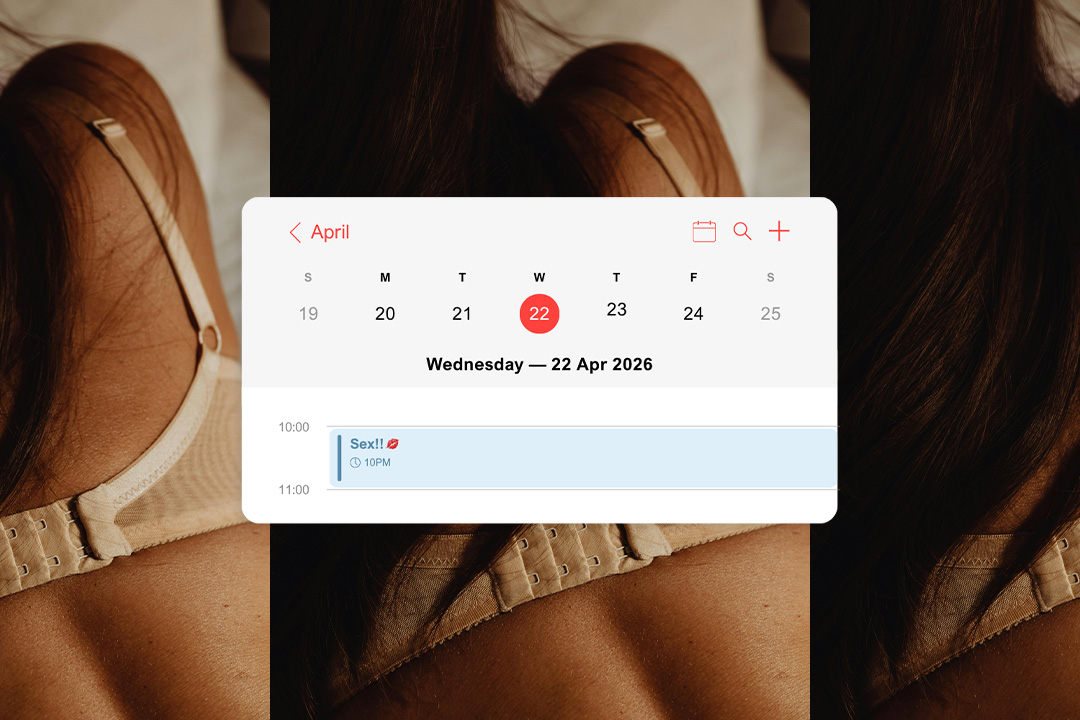
“Saturday sexy time.” That’s what my partner and I called our “sex dates.” A standing appointment on the calendar, color-coded in pink. But every single week, as Saturday got closer, I didn’t look forward to them—at all. I got anxious, stressed out, and sweaty. By Friday afternoon, I was already in my head about our planned intimacy. Then by Saturday morning, like clockwork, I’d find myself rehearsing through excuses to avoid it altogether. By the time the date actually rolled around, instead of feeling like I was going to have fun, I felt more like I was getting ready for a root canal. It was the worst. I was tired of scheduling sex.
I felt like such a terrible partner. Because everyone was telling me scheduling sex was the answer: the therapists, the articles, the “just put it on the calendar!” advice. So why wasn’t it working for me? What was wrong with me that was causing me to dread it instead?
Here’s the punchline: I’m a sex therapist. I literally specialize in helping women increase their libido and enjoy sex more. And I still fell into this trap. So, if you’ve tried scheduling sex with your partner, and it made things feel worse instead of better—you’re not doing it wrong. And there’s nothing wrong with you. The advice itself is the problem. If you hate scheduled sex, I’m here to give advice on what to do instead.
Related Stories:
- Sex and Motherhood: Our Readers Share the Real Scoop on Their Sex Lives
- The Importance of Creating an Atmosphere for Foreplay and Sex
- NSFW: 15 Sex Toys You Didn’t Know You Needed
Why scheduling sex doesn’t work
Here’s the short version of the science because it actually makes everything click: your brain runs two competing systems. There’s a safety mode (calm, regulated, connected). Your sex drive lives in this mode, and it has a great time there. Then there’s a survival mode (aka fight-or-flight), which kicks in when your brain registers stress or pressure. Here’s the catch: those two systems can’t run at the same time. When one’s on, the other shuts off.
Scheduling sex works great in theory. But in practice, for a lot of moms, it turns sex into an obligation. You may feel it especially when you’re exhausted, touched out, and haven’t had any time to yourself in days. The moment it starts feeling like a chore on your never-ending to-do list, your nervous system thinks “Stress! I don’t want to! Let’s avoid that!” And it gets even worse when we feel guilty about feeling that way. So the calendar didn’t kill your sex drive. The pressure did. And pressure is exactly what scheduling creates.
The good news? There are ways to actually work with your nervous system instead of against it. And my tips are a lot more fun than a color-coded calendar.

6 things to try instead of scheduling sex
1. Make physical connection pressure-free
One of the fastest ways to retrain your nervous system is to start stacking small, non-loaded physical connections into your day. Research has shown that a six-second kiss or a 20-second hug triggers oxytocin (the “cuddle chemical” in the brain) and actively downregulates your nervous system’s stress response. You feel safe, and safety is what you want to feel more often to trigger your sex drive more easily.
The rule: these touches go nowhere, and they’re not foreplay. That means they’re not meant to lead up to something else, like sex. The act of physical connection in this case isn’t someone climbing on you or tugging at you. In fact, they’re just connections for connection’s sake. That distinction, like knowing a hug is just a hug, is what makes your body start to lower its guard.
2. Plan a date night where sex is explicitly off the table
Don’t go into a date night with the mentality of “Maybe we’ll see how the night goes.” And don’t allow yourself to give in by saying “No pressure, but…” Actually say, “This date is just for fun,” and “No sex tonight,” out loud to your partner beforehand.
It sounds counterintuitive, but when the looming “maybe later” is removed from the equation, something shifts. You still get excited to have some one-on-one time, but you can actually settle in and enjoy yourself in a whole different way. Laugh. Be goofy. Remember that you genuinely like this person. Ironically, creating a night where sex is 100 percent not happening is one of the best things you can do for your intimacy long-term. It’s because you’re rebuilding the emotional foundation that libido actually needs. So, no sex agenda. It’s just you two simply having fun.
3. Stop defaulting to having sex late at night
The week is finally over, and the kids are finally asleep. It’s nice to finally be horizontal in your bed, especially if you haven’t sat down since 7 a.m. If your nervous system is running on fumes by 8 p.m., it’s understandable why you loathe scheduled sex.
If sex keeps happening at your most depleted, exhausted moment of the day, of course, it’s going to feel like a chore. Your body has nothing left to give. Instead, get curious about when you actually feel most like a human being. Is it Saturday morning before the chaos kicks in? Maybe it’s a Tuesday afternoon when the kids are at school. Or it could be that magical window when your kiddos are at grandma’s and you get to take a quiet, leisurely shower. When you need a brain break from work, maybe it’s during a random Wednesday lunch break.
Sex doesn’t have to happen in bed at night either. Redefining when and where sex happens elevates the experience because you’re way more likely to have better sex when you’re actually honest about what works for you. Most importantly, this makes you more likely to want to do it again.
4. Name when you’re feeling ‘touched out’
There is a real, physical phenomenon that happens when you’ve spent all day being grabbed, climbed on, needed, and touched by small humans. Your nervous system hits a sensory ceiling. You’re not the only one if you don’t want to be touched by anyone for a while. It’s called sensory overload, and it is not the same thing as not wanting your spouse.
But if you don’t name that distinction (to yourself and to your partner), it can show up as you pulling away, getting quiet, and staying on your side of the couch. Your partner may read that as rejection or lack of interest in them. This could lead to distance you both don’t want, especially if it’s a giant misunderstanding.
Try this instead: “I’m so touched out right now. Give me 30 minutes to decompress, and then I actually want to be close to you.” That communication does more for your intimacy than almost anything else on this list because it keeps communication and connection open—instead of shutting them down.

5. Reconnect with pleasure outside of sex first
This one might sound a little out there, but stay with me. When stress and pressure have been running the show for a while (and especially when you’re busy thinking about everyone else over yourself), your brain’s ability to even feel pleasure—any pleasure—goes offline. It’s not that you can’t actually feel things. It’s that we get too checked out and exhausted to actually tune into the good things.
Mindfulness research shows that women who practice sensory awareness outside of sex have a much easier time getting aroused. It’s not because they’re suddenly better at sex. Their skills are actually exactly the same, but they’ve gotten better at being in their bodies and connecting to pleasurable sensations.
“Women who practice sensory awareness outside of sex have a much easier time getting aroused.”
My advice is to try connecting to this awareness during things you already do. This can look like feeling hot water run through your hair and down your back in the shower. Or instead of slapping on lotion, cue into what it feels like: slow down, enjoy the scent, and give your muscles a little massage. Another example is eating something you love (without scrolling on your phone or watching Netflix), and paying attention to how it tastes, the texture, and how it feels in your mouth. To be clear, none of this is sexual. This exercise is tuning the instrument. And a tuned instrument plays a lot better when the moment actually comes.
6. Bring novelty into your daily life, not just the bedroom
Your sex drive feeds on dopamine, and dopamine loves ‘newness.’ Not necessarily in a “let’s try something edgy in the bedroom” kind of way. It’s the exciting feeling of “my brain is actually engaged and interested in this fun new thing.”
Some ways to bring novelty into your life are going to a restaurant you’ve never been to, taking a different route on your walk, and playing a new game together with the kids. Novelty creates an upward connection spiral so you feel more engaged, more alive, and more like yourself. That energy spills into everything, including how you may feel about your partner (and the whole family unit). This helps you both bring your best selves when you’re spending quality time together. Naturally, the vibes feel more like they did in the early days of your relationship (when everything was new!).
Why these tips work
As a sex therapist, these tips do work. In fact, I’ve done them myself and worked with enough moms struggling to increase libido to know they’re helpful. But a key piece of this puzzle is knowing how your sex drive actually works. Libido can look different for everyone. However, knowing how to connect (other than scheduling sex) can change everything about how you approach intimacy.
If you’re reading this, looking for answers on how to make sex fun again, you’ve already done the hard part of acknowledging that scheduled sex feels like a dreaded dentist appointment. So, I’m here to tell you that it’s OK to cancel that appointment and use the tips above to start doing what actually works for you instead. Trust me, it’s so much easier (and more fun) on the other side.

Erinn Hoel, Contributing Writer
As a sex therapist with 10 years’ experience, Erinn created the Desire to Fire Method to help women stop dreading sex and start actually wanting it (and enjoying it) again. When she’s not showing women diagrams of the clitoris, you can find her on a running trail (flat ones only, no hills) or adding books to a ‘to-read’ list that is completely out of control.
